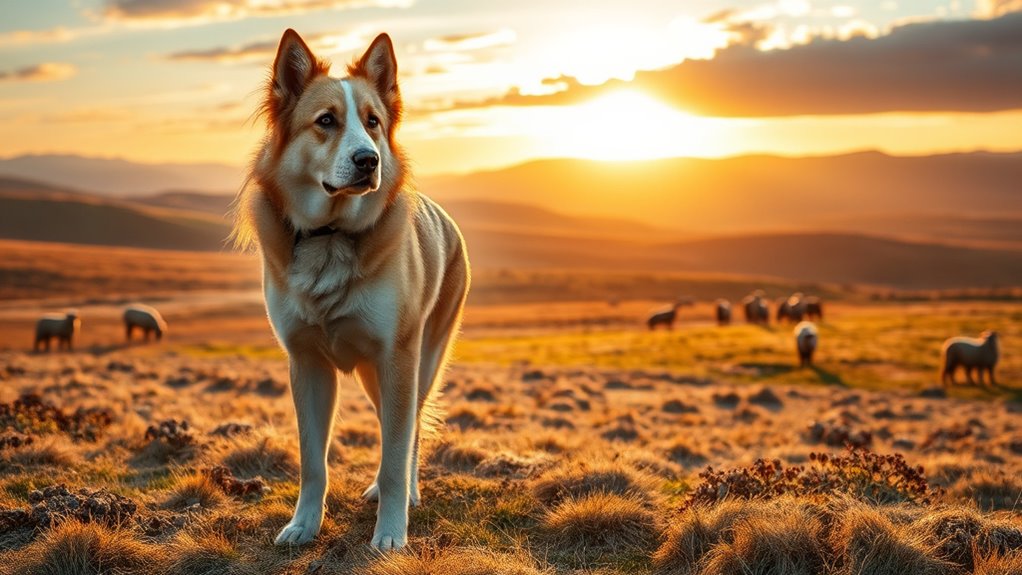

Livestock guardian dogs are specialized breeds like the Great Pyrenees, Anatolian Shepherd, and Maremma Toscana, developed over centuries to protect flocks and herds from predators. These dogs are large, calm, and independent, with natural guarding instincts. Proper training focuses on harnessing their innate qualities through early socialization, consistent positive reinforcement, and boundary-setting. Knowing each breed’s history guarantees you choose the right dog for your needs. If you continue exploring, you’ll discover how to best train and pair these incredible protectors.
Key Takeaways
- Familiarize with breeds like Great Pyrenees, Anatolian Shepherd, and Maremma Toscana, understanding their origins and characteristic traits.
- Select a breed suited to your environment and livestock needs based on their natural instincts and temperament.
- Begin early socialization to develop balanced behavior, exposing dogs to various stimuli and livestock interactions.
- Use positive reinforcement training to strengthen natural guarding instincts and establish boundaries and commands.
- Maintain consistent management, including regular health checks and monitoring, to ensure effective protection and well-being of the guardian dogs.

Have you ever wondered how ranchers protect their livestock from predators? One of the most effective methods involves using livestock guardian dogs, which have been around for thousands of years. These dogs are not just pets; they’re working animals with a rich history rooted in the needs of early herders and farmers. Their historical origins trace back to ancient civilizations, where large, protective dogs were bred specifically to guard flocks and herds. For example, breeds like the Great Pyrenees, Anatolian Shepherd, and Maremma Toscana have deep roots in regions such as the Pyrenees Mountains, Anatolia, and Italy, respectively. These breeds were developed in rugged environments, which shaped their breed characteristics—sturdy frames, thick coats, and keen instincts to detect and confront predators. They were selected for their strength, independence, and loyalty, making them ideal for guarding livestock in open pastures or remote farms.
Breed characteristics vary among these guardian dogs but share common traits that make them uniquely suited for the role. Typically, they’re large, powerful dogs with a calm yet assertive demeanor. Their thick coats help protect them against harsh weather, from freezing cold to intense heat. They tend to be independent and confident, often patrolling the perimeter without much supervision. Their alertness makes them excellent at detecting threats, and they usually confront predators rather than run away. Most are naturally protective, forming strong bonds with their livestock and owner, and they often display a quiet, watchful presence that deters potential threats. These breed characteristics make them different from herding or hunting dogs, as they focus primarily on protection rather than active herding or chasing.
Understanding their historical origins and breed traits helps you appreciate why these dogs are so effective. They’re not just aggressive; they’re bred to be vigilant, calm, and resilient. Properly selecting a breed that fits your environment and needs is essential, whether you’re protecting goats, sheep, cattle, or other livestock. Training these dogs involves harnessing their natural instincts, teaching them boundaries, and building a trusting relationship. They need to learn to distinguish between normal activity and genuine threats, so they don’t become overly aggressive or overly passive. Consistent, positive reinforcement and early socialization are key to ensuring they grow into confident guardians. Additionally, understanding breed history enhances your ability to match a guardian dog to your specific livestock needs, ensuring a harmonious and effective partnership. To put it another way, understanding their historical roots and breed traits of livestock guardian dogs helps you comprehend their role in modern livestock management, and how to best utilize their natural skills to keep your animals safe.

Forestpaw Heavy Duty No Pull Dog Harness for Training-Tactical Vest with 3 Metal Rings,Soft Padded Sled Harness for Small Head Medium Large Dogs,Chest fits 25-31.5"
Size M: Chest 25–31.5",Neck/Head 20"(non-adjustable), Strap Width 2".Pro Tip:Use a soft tape to measure your dog's chest,neck and…
As an affiliate, we earn on qualifying purchases.
As an affiliate, we earn on qualifying purchases.
Frequently Asked Questions
How Do I Choose the Right Livestock Guardian Dog Breed for My Farm?
To choose the right livestock guardian dog breed, consider their breed characteristics and farm environment suitability. Think about the size, temperament, and energy levels that match your farm’s needs. If you have large, open spaces, breeds like the Maremma or Great Pyrenees work well. For smaller farms, Anatolian Shepherds or Kangal dogs might suit better. Match the breed’s traits to your farm’s terrain, livestock type, and your ability to provide training and care.
What Are Common Behavioral Issues in Livestock Guardian Dogs?
You might notice behavioral issues like dominance problems or separation anxiety in your livestock guardian dog. These issues can lead to aggressive tendencies or destructive behavior when alone. To address them, guarantee consistent training, socialization, and gradual independence building. Regular exercise and mental stimulation help reduce anxiety, while clear boundaries can curb dominance. Addressing these behaviors early keeps your dog balanced and effective in protecting your livestock.
How Much Exercise Do Livestock Guardian Dogs Need Daily?
Think of your livestock guardian dog as a roaring river needing steady flow. They require about 1 to 2 hours of dog exercise needs each day to stay healthy and happy. Their daily activity levels should include vigorous walks, playtime, and mental stimulation. Without enough exercise, they may become bored or restless, risking behavioral issues. Keep their energy channeled positively for a calm, alert guardian.
Can Livestock Guardian Dogs Live With Other Pets?
Yes, livestock guardian dogs can live with other pets if you use proper socialization strategies. You should introduce your guardian dog to compatible pets gradually and supervise their interactions closely. Consistent positive reinforcement helps build trust and reduces territorial instincts. Keep in mind that individual temperaments vary, so patience and gradual integration are key to ensuring harmonious coexistence between your livestock guardian dog and other pets.
What Are Signs of Health Problems in Livestock Guardian Dogs?
Imagine noticing your dog’s eyes dull, or their coat losing shine—that’s a sign of health problems. You should watch for early symptoms like decreased appetite, limping, or unusual lethargy. These clues indicate potential issues with dog health. Regular check-ups and observing changes help catch problems early, ensuring your livestock guardian dog stays strong and alert to protect your livestock effectively.

Jugbow Dog Shock Collar – 4500FT Dog Training Collar with Remote, IPX8 Waterproof Electric Dog Collar with 4 Training Modes, Security Lock, Rechargeable eCollar for 10-120lbs Small Medium Large Dogs
[4 Effective Training Mode – Recall & Correct Unwanted Dog Behavior] Featuring advanced Safe-Tech with 4 modes: Beep(1-8),…
As an affiliate, we earn on qualifying purchases.
As an affiliate, we earn on qualifying purchases.
Conclusion
Livestock guardian dogs are fierce protectors, yet gentle companions when it matters most. Their imposing presence keeps predators at bay, but their loyal hearts foster trust with you and your animals. While they may seem intimidating, they’re also tender guardians who thrive on bond and duty. In a world of threats and trust, these dogs stand as a bold shield and a gentle friend—proof that strength and kindness can coexist beautifully.

Zozen 100Pack White Marking Flags, Writable/15x4x5 Inch, Yard Flags for Lawn & Irrigation & Landscape & Sprinkler & Survey & Dog Training.
⛳【PVC MARKING FLAGS】 – Our marker flags are glued on, not wrapped, which makes them much harder to…
As an affiliate, we earn on qualifying purchases.
As an affiliate, we earn on qualifying purchases.

CheckUp Pro at Home Wellness Test for Dogs | Telescopic Pole, Reusable Cup, 2 Strips | Detection of 10 Indicators | pH, Protein, Urobilinogen, Glucose, Bilirubin, Ketone, S-Gravity, Blood in Urine
EXTENDABLE P-POLE & WASHABLE CUP: Lightweight telescopic pole keeps you safely out of the splash zone while the…
As an affiliate, we earn on qualifying purchases.
As an affiliate, we earn on qualifying purchases.