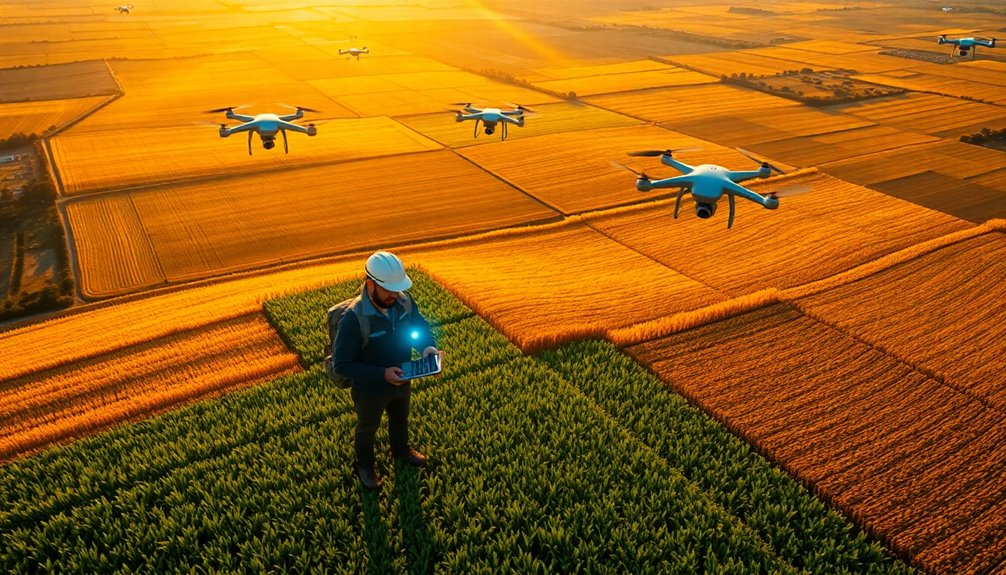

Integrating AI chatbots into farm advisory services lets you access expert guidance anytime, anywhere. These chatbots offer instant, personalized advice on crop health, pests, and planting schedules, helping you make timely decisions. They’re easy to use and build confidence in new technologies, encouraging more proactive farming. By providing tailored insights based on local data, they support sustainable practices and boost productivity. Continue exploring to discover how this innovation can transform your farm management.
Key Takeaways
- Enhance farmer engagement by providing 24/7, personalized, and immediate farm advisory support tailored to local conditions.
- Simplify technology adoption through user-friendly interfaces, encouraging seamless integration into daily farming routines.
- Deliver data-driven recommendations by analyzing weather, soil, and crop data for precise, context-specific advice.
- Promote continuous learning by sharing the latest research, innovations, and best practices within farming communities.
- Boost farmer confidence and sustainability by supporting informed decision-making and fostering adaptable, efficient farming practices.
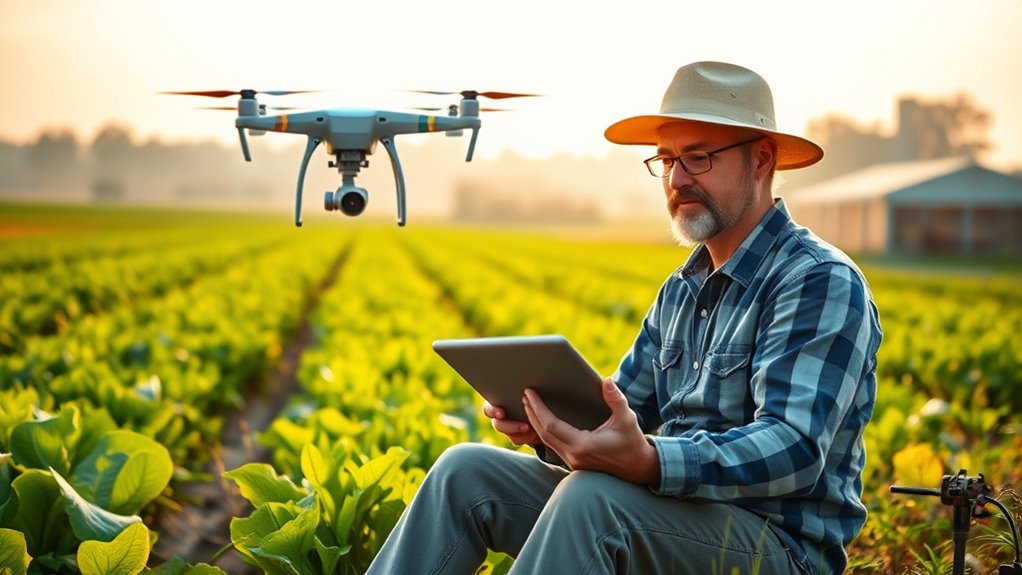
Integrating AI chatbots into farm advisory services is transforming how farmers access essential information. Instead of waiting for in-person visits or relying solely on traditional methods, you now have a digital assistant available around the clock, ready to answer your questions and guide your decisions. This shift boosts farmer engagement because these chatbots make information more accessible and personalized. When you’re unsure about crop diseases, pest management, or ideal planting times, the chatbot provides instant insights tailored to your specific farm conditions. This immediacy encourages you to seek advice more frequently, fostering a proactive approach to farm management that wasn’t as feasible before. As a result, technology adoption accelerates because you become more comfortable using digital tools that directly benefit your productivity and income. The chatbot’s user-friendly interface reduces the intimidation often associated with new technology, helping you integrate these tools seamlessly into your daily routines. Moreover, these chatbots can analyze local data to offer more precise recommendations, increasing the relevance and effectiveness of the advice given. You’re likely to find that AI chatbots help you overcome barriers like distance or lack of access to expert advice. If you’re operating in remote areas or limited by time constraints, the chatbot serves as a reliable source of support, providing timely recommendations based on weather updates, soil data, or crop growth stages. This constant availability encourages you to explore and experiment with new practices without feeling overwhelmed or isolated. As you become more engaged with these digital tools, your willingness to adopt innovative farming techniques grows. The chatbot often links you to additional resources, training modules, or local service providers, making the shift to new methods smoother. Over time, you develop confidence in technology, seeing it not as a replacement but as a valuable extension of your traditional knowledge. Furthermore, the integration of AI chatbots helps you stay updated with the latest agricultural research and best practices. Instead of sifting through multiple sources, you can simply ask your chatbot about recent innovations or policy changes relevant to your farm. This instant access to current information keeps you competitive and adaptable in a rapidly changing agricultural landscape. As more farmers engage with these tools regularly, communities collectively benefit from shared knowledge, leading to higher overall productivity and sustainability. The experience of using AI chatbots fosters a culture of continuous learning and openness to adopting new technologies, which is vital for modern farming. Overall, by enhancing farmer engagement and encouraging technology adoption, AI chatbots are revolutionizing farm advisory services, making them more responsive, efficient, and tailored to your needs.
Top picks for "integrat chatbot farm"
Open Amazon search results for this keyword.
As an affiliate, we earn on qualifying purchases.
Frequently Asked Questions
How Do AI Chatbots Handle Regional Language Differences?
AI chatbots handle regional dialects and multilingual support by utilizing advanced language models and extensive local data. They’re trained to recognize and interpret regional variations, allowing for more accurate communication. You’ll find that these chatbots can switch seamlessly between languages and dialects, making farm advisory services more accessible. This adaptability guarantees farmers get relevant advice in their native language, improving understanding and decision-making in diverse regional contexts.
What Are the Costs Associated With Implementing AI Chatbots?
You’ll find that costs for implementing AI chatbots involve a thorough cost analysis, covering development, deployment, and ongoing maintenance. You face implementation challenges like infrastructure upgrades and training needs, which can add to expenses. Budget considerations include licensing fees, server costs, and support services. By understanding these factors, you can better plan your investment, ensuring your farm advisory services become more efficient without unexpected financial hurdles.
How Is Data Privacy Maintained With Ai-Driven Farm Advice?
You maintain data privacy by using data encryption to protect sensitive farm information and ensuring user consent before collecting any data. This way, you control what data is shared and how it’s stored. Regular security audits help identify vulnerabilities, giving you confidence that your farm advice remains confidential. By prioritizing encryption and transparency, you safeguard your data while benefiting from AI-driven insights.
Can AI Chatbots Replace Human Farm Advisors Entirely?
AI chatbots can’t replace human farm advisors entirely; they’re like a map, guiding you but not the journey itself. While they can handle routine questions, chatbot limitations mean they lack farmer trust and nuanced understanding. You still need human insight for complex decisions. Trust in advisors builds through experience, so AI acts as a helpful tool, not a complete substitute, ensuring you get personalized advice rooted in deep knowledge.
How Do Chatbots Adapt to Changing Agricultural Regulations?
You can keep chatbots up-to-date with changing agricultural regulations by regularly updating their databases with the latest policy updates. They adapt to new rules by integrating real-time data from government sources and industry bodies, ensuring regulatory compliance. This proactive approach allows the chatbots to provide accurate advice aligned with current policies, helping farmers stay compliant and avoid penalties. Continuous learning and updates are key to maintaining their effectiveness.
Conclusion
By integrating AI chatbots into farm advisory services, you can boost productivity and make informed decisions easily. Did you know that farms using AI-driven tools see up to a 30% increase in crop yields? Embracing this technology not only enhances your farm’s efficiency but also connects you to real-time expert advice. So, take advantage of AI chatbots today and watch your farming success grow exponentially.