
TL;DR

Get garden gear delivered free with Prime
- Fast, free delivery on millions of items
- Prime Video, Amazon Music and more included
- Member-only deals all year
Anthropic’s $65 billion Series H isn’t merely a valuation milestone; it’s a capacity round focused on securing chips, cloud capacity, and hardware supply chains. This signals that compute is now the key bottleneck in scaling AI, with infrastructure investments driving the company’s explosive growth.
When a private AI company surpasses a trillion-dollar valuation, it’s easy to assume it’s all about the algorithms and data. But behind the headlines of a $65 billion raise and a $965 billion valuation, something bigger is happening. This isn’t just money chasing AI innovations — it’s a massive infrastructure push.
Anthropic’s recent move is a clear message: the real bottleneck isn’t just creating smarter models. It’s having enough chips, cloud capacity, and memory to train and run those models at scale. This article pulls back the curtain on what what this funding round really means for AI’s future.
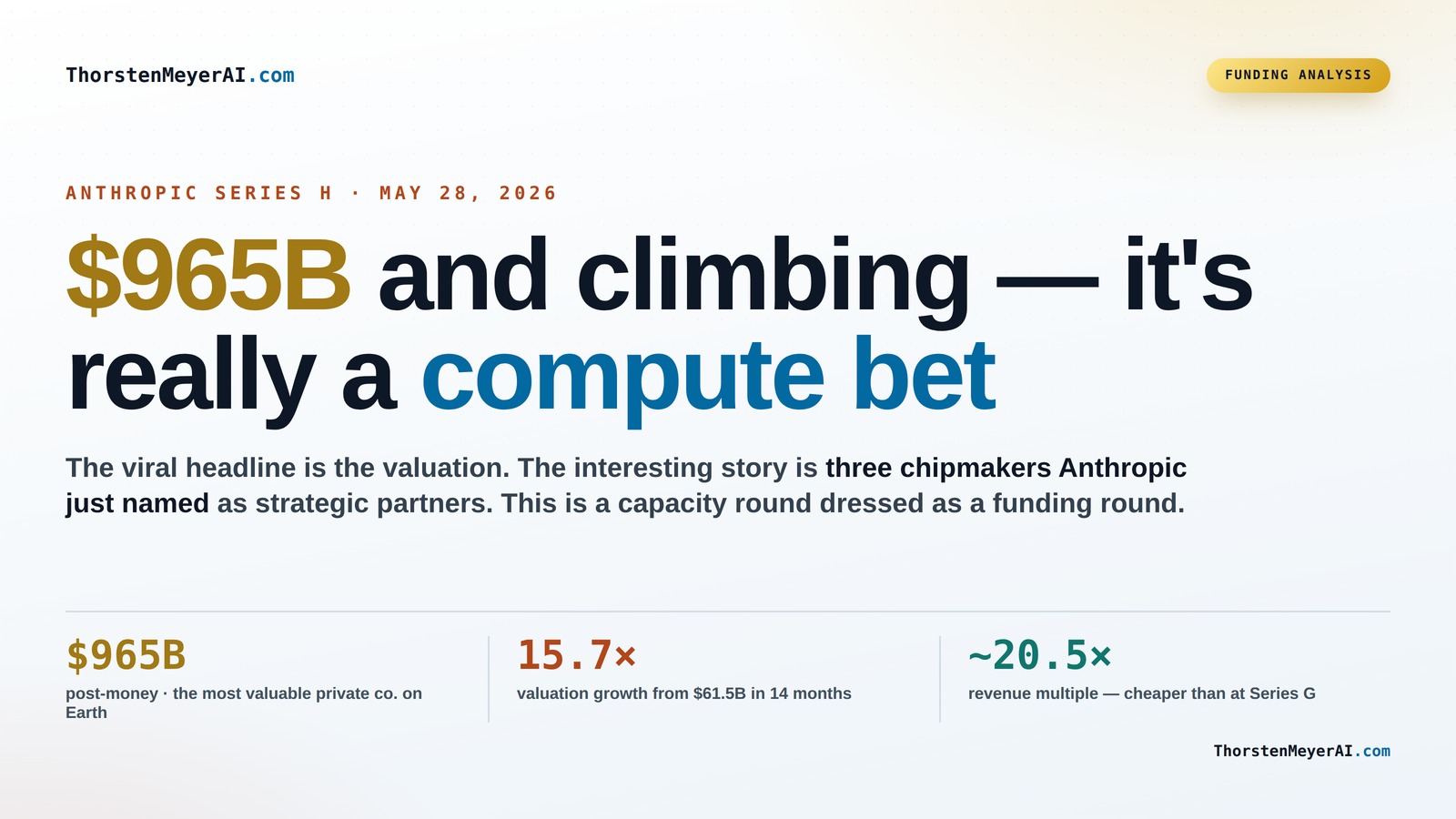
$965B and climbing — it’s really a compute bet
The viral headline is the valuation. The interesting story is in the press release’s middle paragraphs — and in three chipmakers Anthropic just named as strategic partners. This is a capacity round dressed as a funding round.
The numbers nobody can quite parse in sequence
Read together they describe a trajectory with no precedent in enterprise software. Read individually, each looks like a typo.
From $61.5B to $965B in fourteen months
Salesforce took roughly two decades to reach revenue numbers Anthropic just blew past. The sequence below is the part most coverage skips — it’s not the size, it’s the shape.
Anthropic’s valuation ladder · Mar 2025 → May 2026
Five rounds, fourteen months. Bar height is the valuation; the climb itself is the story. Tap any milestone for context.
The multiple actually got cheaper
Bubbles look like multiples expanding while revenue lags. Anthropic’s pattern is the inverse — the valuation tripled, but revenue grew faster, and the multiple compressed.
Revenue-to-valuation multiple · Series G → Series H
Same company, three months apart. The denominator (revenue) is outrunning the numerator (valuation) — exactly the opposite of what a bubble narrative predicts.
10+ gigawatts and three chipmakers
When you name Micron, Samsung & SK hynix alongside your equity backers, you’re saying the binding constraint isn’t demand or model quality — it’s the physical supply of memory chips. The Series H is a capacity round.
Compute commitments backing Anthropic’s capacity bet
$200B+ in announced compute spend across multi-year contracts. The $65B Series H raise has to be read against that bill, not against operating losses.
A genuinely durable bet — or a structural exposure?
Both readings can be true at once. The answer arrives over the next 18–24 months as the gigawatts come online and either fill with paying demand or don’t.
Revenue growth has no precedent in B2B software ($1B → $47B in 17 months). The multiple is compressing, not expanding. Claude is the only frontier model on all 3 major clouds. Enterprise AI spend share went from ~10% to >65% in a year. Compute commitments are tied to specific contracts with capacity dates.
20× revenue is not cheap by any historical software-investing standard. Revenue is reported gross of cloud-reseller pass-throughs, which inflates the top line. Profitability is 2 years out. Amodei’s own warning: a 12-month delay in AI progress “would make him bankrupt” — the compute commitments are a structural exposure to demand persistence.
The valuation race — and the IPO context
Anthropic shipped Opus 4.8 the same morning as Series H — not a coincidence. One week after OpenAI filed confidentially for IPO. The late-2026 frame is set: two frontier AI companies racing to public markets, each pitching durability.
Key Takeaways
- Anthropic’s $65 billion Series H is primarily a strategic infrastructure investment, not just a valuation milestone.
- The company’s focus on securing chips and cloud capacity signals hardware supply chains are now core to AI scaling.
- Despite the massive valuation, Anthropic’s revenue growth is outpacing its multiples, indicating a focus on capacity over pure profit.
- This round shows that the AI race is shifting from algorithmic innovation to physical infrastructure dominance.
- For investors and startups, owning and controlling hardware supply chains will soon be as critical as developing models.
As an affiliate, we earn on qualifying purchases.
Why This Funding Round Is Really About Hardware, Not Just Growth
Anthropic’s $65 billion raise isn’t your typical startup cash injection. It’s a strategic play to secure access to the physical infrastructure needed for AI at scale. Think of it as a giant hardware and supply chain insurance policy wrapped in a valuation boost.
They’ve named chipmakers like Micron, Samsung, and SK hynix as “strategic partners,” with commitments for over 10 gigawatts of compute capacity. That’s enough to power thousands of the latest GPUs — the heart of AI training.
Imagine the scene: a company with a valuation larger than most countries, pouring billions into securing chips and cloud capacity — because without this hardware, their models are just fancy code on a limited number of servers.

How Anthropic’s Valuation Surpassed OpenAI’s — And Why It Matters
Anthropic’s valuation hit $965 billion, making it the most valuable private AI company, even beating OpenAI’s $852 billion. But here’s the twist: the valuation is based on future capacity and infrastructure investments, not just current revenue or profits.
While OpenAI trades at a roughly 30× revenue multiple, Anthropic’s multiple is around 20.5× — lower, despite its higher valuation. That’s because revenue growth is outpacing valuation increases, a sign of rapid, infrastructure-driven scaling.
This shift shows that in AI, the race isn’t just about better models. It’s about having the hardware and supply chain to run them — a game-changing shift for the industry’s economics.

Revenue Explosion — How Anthropic Went From $9B to $47B in Just Months
Anthropic’s reported revenue skyrocketed from about $9 billion at the end of 2025 to over $47 billion in early May 2026. That’s a 5.4× jump in just a few months. How? Demand for AI services is exploding, fueling cloud and compute needs at an unprecedented pace.
For example, in Q2 2026, analysts project over $10.9 billion in revenue — more than the entire 2025 total. The company’s usage and revenue are growing so fast that their annualized rate could top $50 billion by summer’s end.
This rapid revenue boost underscores that demand for AI is no longer just about research. It’s a full-blown industry shift, demanding vast, scalable infrastructure to keep up.

The Real Power of the Capacity Round — Securing Chips and Cloud Capacity
This isn’t just a funding round; it’s a capacity round. Anthropic’s commitments to chipmakers and hyperscalers mean billions are flowing back into the supply chain. Amazon’s $5 billion contribution and deals with Micron, Samsung, and SK hynix point to a strategic push for control over hardware supply.
Picture a company funneling billions into buying specialized chips, locking in cloud capacity, and building an ecosystem that makes AI scaling a physical reality, not just a technical challenge.
This shift is a seismic change. It means that the race to scale AI models is now as much about owning hardware as it is about algorithms.

What Does All This Mean for the Future of AI Infrastructure?
AI’s future isn’t just about smarter models — it’s about having enough chips, servers, and power to run them. The $965 billion valuation signals that infrastructure is the new frontier. Companies will compete over access to hardware, and supply chains will become strategic assets.
For startups and giants alike, securing hardware and cloud capacity is now a key part of their growth story. This makes the AI race less about innovation alone and more about physical capacity and logistics.
Imagine a world where the bottleneck is no longer data or algorithms but the supply of chips and power — that’s the new battleground.
Frequently Asked Questions
Is Anthropic really worth $965 billion, or is that just a funding round price?
The $965 billion valuation reflects investor expectations for Anthropic’s future capacity and infrastructure dominance, not just current revenue. It’s a strategic bet on the physical resources needed to scale AI models.Why is this called a ‘compute deal’ instead of a typical startup raise?
Because a significant part of the funding is dedicated to securing chips, cloud capacity, and supply chain commitments. It’s about building the physical foundation for AI’s massive growth, not just funding product development.How much of the $65 billion is new money versus existing infrastructure commitments?
While a large portion is new primary capital, much of it is tied to or flows back into infrastructure partners like chipmakers and cloud providers, effectively recycling into hardware and capacity investments.What exactly will Anthropic spend the money on?
Primarily on GPUs, cloud contracts, hardware supply chain commitments, and expanding their infrastructure footprint — essentially locking in the physical capacity necessary for AI training and inference.Does this round suggest Anthropic is preparing for an IPO?
Not necessarily. It signals a focus on infrastructure and capacity building. While future IPO plans could follow, the current emphasis is on controlling the physical backbone of AI scaling.Conclusion
This isn’t just another tech funding story. It’s a sign that AI’s future depends on the chips, servers, and power behind the scenes. The real race now is for physical infrastructure — a game where control over supply chains equals power.
As Anthropic’s story unfolds, ask yourself: who will own the hardware that powers tomorrow’s AI? The answer may decide who leads the next chapter of AI innovation.

Fall yard work Picks
leaf blowers
As an affiliate, we earn on qualifying purchases.