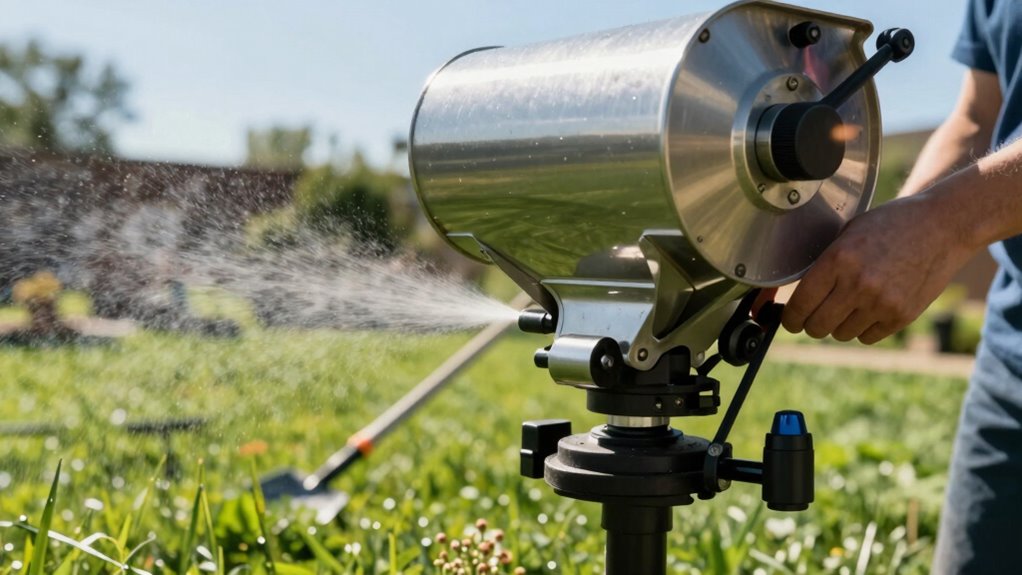
To stop over-seeding instantly, start by calibrating your broadcast spreader properly. Fill it with a known seed amount and test its output over a measured area. Adjust the setting until the seed rate matches your desired coverage, then repeat to guarantee accuracy. Keep your spreader clean and check calibration regularly to maintain precise distribution. If you’re serious about avoiding over-seeding, follow these steps closely—you’ll discover how to perfect your spreader in no time.
Key Takeaways
- Always calibrate your spreader before each use to ensure accurate seed application and prevent over-seeding.
- Measure seed spread rate on a flat surface using calibration tools to set precise distribution.
- Adjust the spreader settings based on test results to achieve the desired seed rate and coverage.
- Regularly inspect and clean the spreader to avoid blockages or damage that cause uneven seed flow.
- Recalibrate periodically, especially after maintenance or changing seed types, to maintain consistent, optimal seeding.
Why Proper Calibration Prevents Over-Seeding and Saves Money
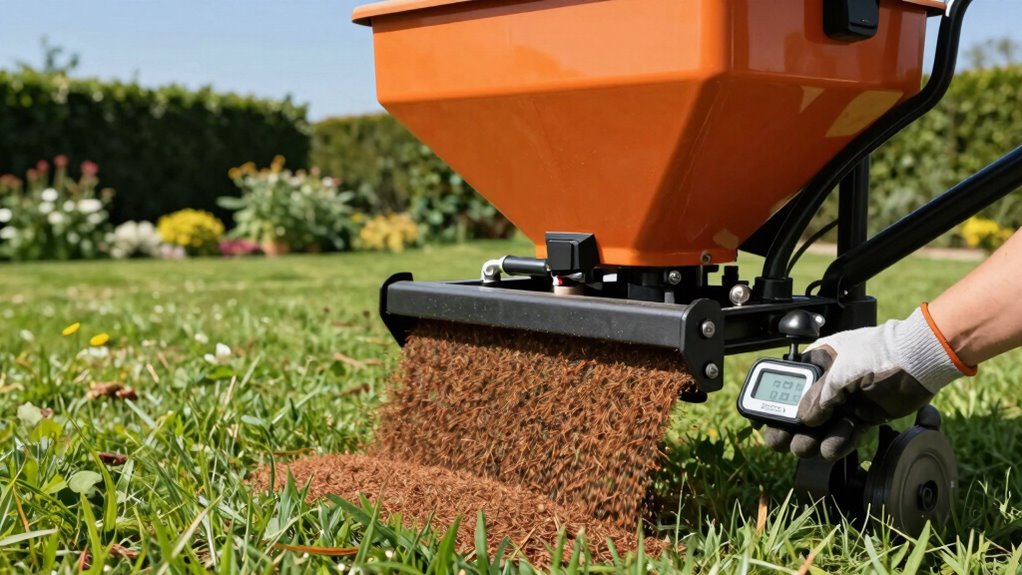
Proper calibration of your broadcast spreader is crucial because it guarantees you’re applying the right amount of seed every time. When you calibrate correctly, you achieve ideal seed distribution, ensuring each section of your lawn gets the perfect coverage. Using calibration tools helps you set your spreader accurately, preventing over-seeding that wastes seed and money. Over-seeding can lead to dense patches, increased mowing, and unnecessary costs for extra seed. By calibrating your spreader, you control the seed flow rate, avoiding waste and promoting healthy growth. Accurate calibration also supports efficient seed application, helping you maximize seed germination and lawn health. Precise seed distribution also minimizes the need for overseeding later, saving you time and effort. Investing in proper calibration ensures you get the most out of your seed and equipment, making lawn care more efficient and budget-friendly. Additionally, understanding the contrast ratio of your equipment can help you better evaluate how visual quality impacts your lawn’s appearance. Proper calibration also enhances the efficiency of seed application, ensuring your lawn receives uniform coverage with minimal waste.
How to Measure Seed Spread Rate for Your Broadcast Spreader
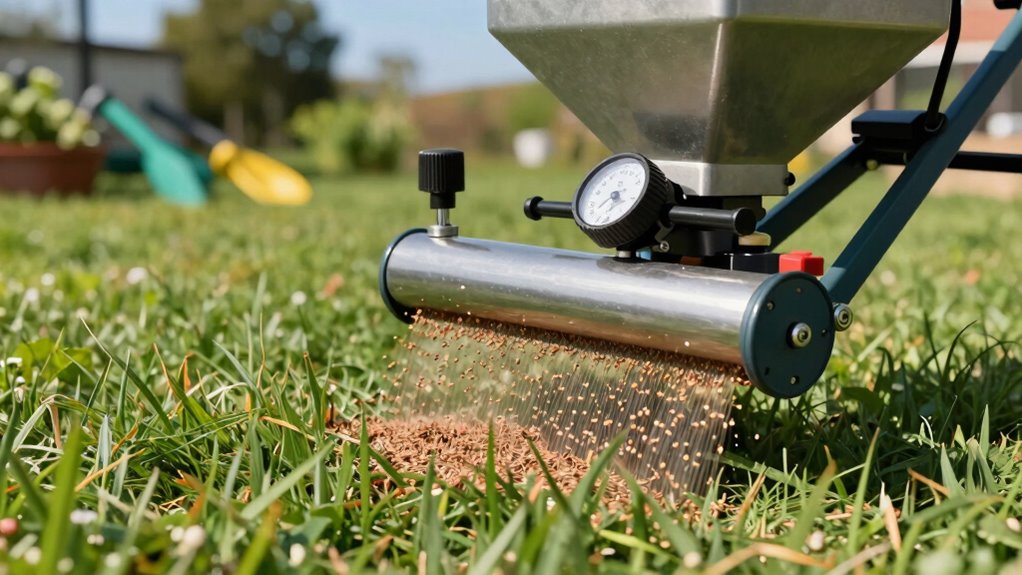
To accurately measure the seed spread rate for your broadcast spreader, start by marking a clean, flat surface with a piece of cardboard or a tarp. Fill your spreader with a known amount of seed, then operate it over the marked area at your usual setting. Measure the amount of seed that lands within the area to determine your seed distribution rate. Use calibration tools like a scale or measuring cup for precise measurements. Record your results to evaluate whether your spreader evenly disperses seed. Keep in mind, consistent seed distribution is key to avoiding over-seeding or under-seeding. Proper calibration ensures you achieve the correct seed rate, saving you seed and effort in the long run. Additionally, understanding seed dispersal techniques can help optimize your calibration process. For example, the type of seed and terrain can affect dispersal accuracy, similar to how electric bikes vary in speed and horsepower. Recognizing the importance of AI in agriculture can also inform better planting strategies. Here’s a simple way to visualize your results:
| Seed Amount | Area Covered | Seed Rate |
|---|---|---|
| 10 oz | 10 ft² | 1 oz/ft² |
| 15 oz | 15 ft² | 1 oz/ft² |
| 20 oz | 20 ft² | 1 oz/ft² |
Regular testing helps guarantee ideal seed distribution, and understanding your spread rate is essential for achieving optimal coverage.
How to Calibrate Your Broadcast Spreader in 5 Easy Steps
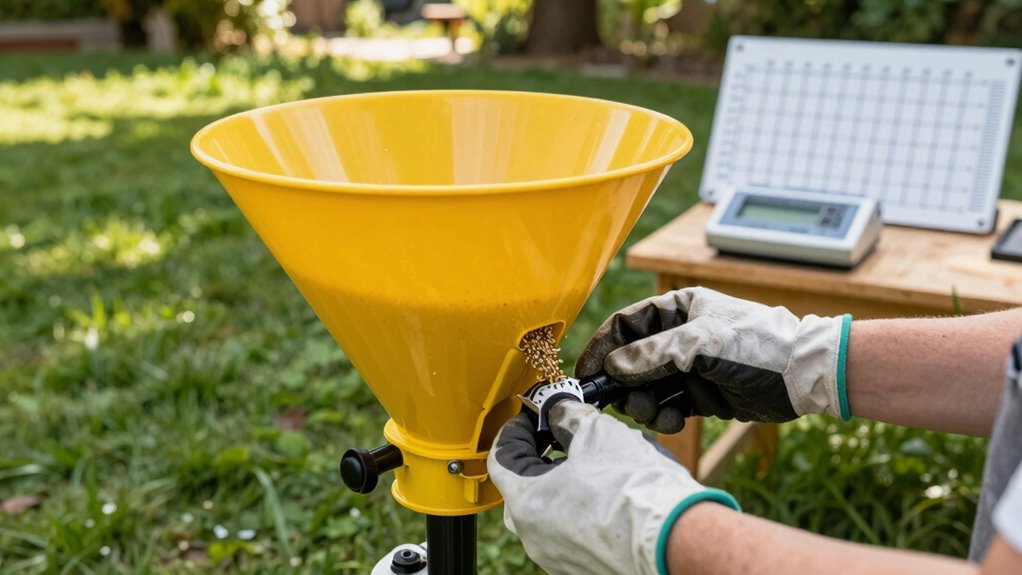
Once you’ve measured your seed spread rate, the next step is to calibrate your broadcast spreader for consistent results. Proper calibration guarantees your seed dispersal matches your target coverage. Start by filling your spreader with a known amount of seed and setting it to your usual settings. Use calibration tools like a scale, measuring container, or a tape measure to track how much seed is dispersed over a specific area. Spread the seed onto a tarp or newspaper to measure the coverage area and quantity. Adjust your spreader’s settings based on these results until you achieve the desired seed dispersal rate. Repeating this process helps maintain accuracy and prevents over-seeding. Calibration tools make this process straightforward, giving you confidence in uniform, efficient seed distribution. Additionally, understanding your spreader’s distribution pattern can help you fine-tune your technique for optimal results.
Troubleshooting Calibration Problems and Fixes
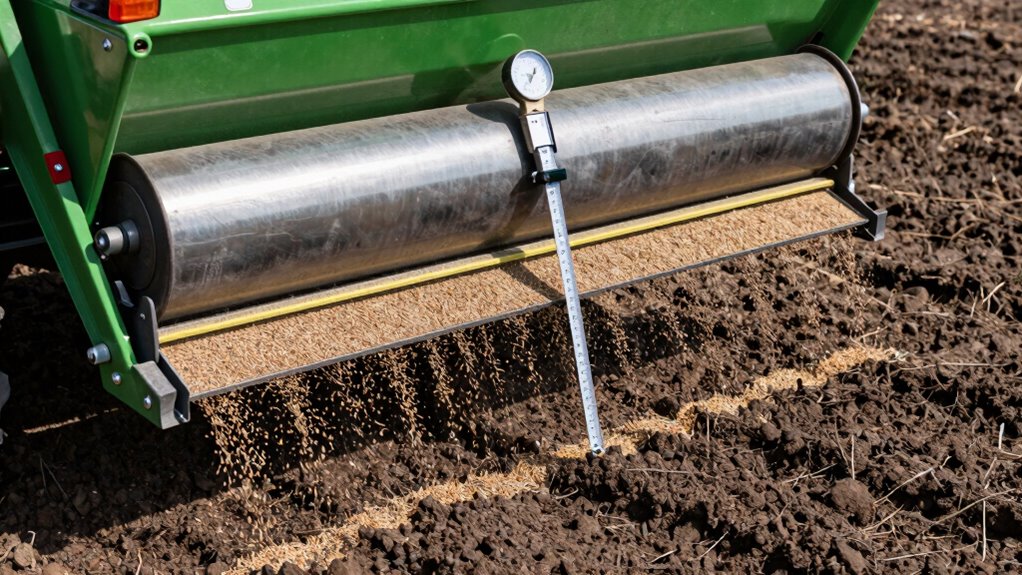
Calibration issues often arise when your spreader doesn’t disperse seeds evenly or consistently, which can lead to over- or under-seeding. To troubleshoot, start by inspecting your spread pattern. If it’s uneven, check for obstructions or damage. Use calibration tools like a scale to measure seed output accurately. Adjust the settings based on your calibration results, ensuring the spread pattern is uniform across the target area. If problems persist, consider the following troubleshooting table:
| Issue | Cause | Fix |
|---|---|---|
| Uneven spread pattern | Blocked or damaged agitator | Clean or replace parts |
| Inconsistent seed output | Incorrect calibration settings | Recalibrate with calibration tools |
| Seeds clumping or sticking | Moisture or debris in hopper | Dry and clear hopper |
| Over-seeding or under-seeding | Misaligned calibration settings | Recalibrate and verify settings |
Additionally, understanding your spread pattern is crucial for ensuring uniform seed distribution and optimal growth. Accurate calibration is key to achieving a reliable spread pattern, especially since understanding spread pattern is crucial for effective seeding.
How to Maintain Accurate Calibration Over Time
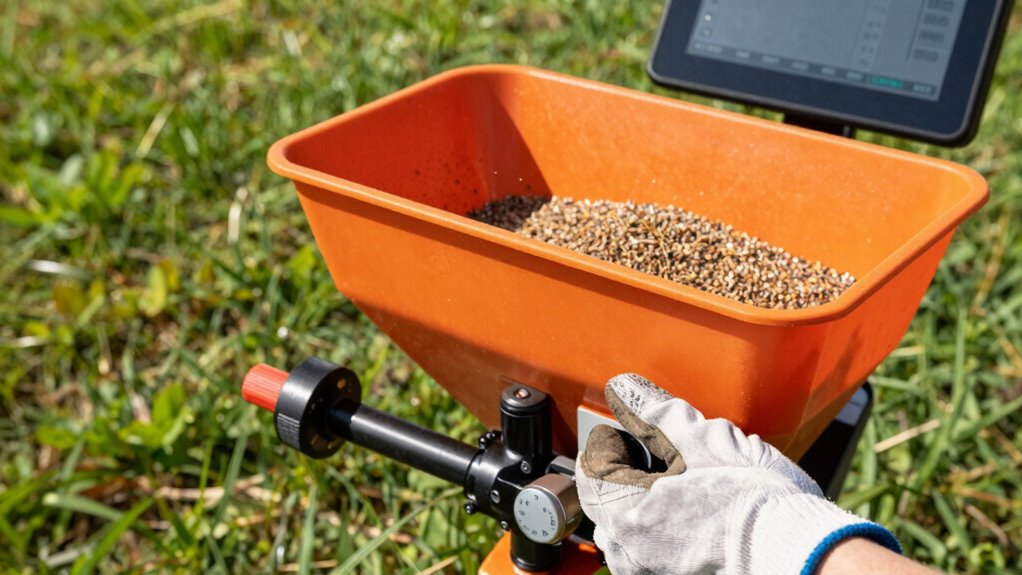
Maintaining accurate calibration over time requires regular attention and adjustments to guarantee your spreader performs consistently. To make certain this, incorporate regular spreader maintenance and use reliable calibration tools. Here’s what you should do:
Regular maintenance and calibration ensure your spreader stays accurate and reliable over time.
- Check calibration after each use to catch any drift early.
- Clean your spreader thoroughly to prevent clogs that affect distribution.
- Inspect and replace worn parts to keep the mechanism precise.
- Recalibrate periodically based on the manufacturer’s recommendations or usage frequency.
- Utilize proper calibration techniques to ensure your spreader remains accurate for safety and effectiveness.
- Ensure proper maintenance of your equipment by following manufacturer-specific maintenance guidelines to prolong its lifespan and maintain precision.
- Remember that understanding net worth can provide insight into the reliability of your equipment and maintenance budget, helping you plan for necessary upgrades or repairs.
- Regularly reviewing your performance metrics can help identify issues before they impact calibration accuracy.
Frequently Asked Questions
Can Calibration Be Affected by Outdoor Weather Conditions?
Yes, weather impact can affect calibration accuracy. When outdoor conditions like wind, humidity, or temperature change, they can alter how your spreader distributes seed or fertilizer. For example, wind may cause uneven spreading, and humidity can affect material flow. To guarantee precise calibration, you should regularly check and adjust your spreader, especially after significant weather changes, so your over-seeding stops instantly and you get even coverage every time.
How Often Should I Recalibrate My Broadcast Spreader?
You should recalibrate your broadcast spreader at least once each season or after making significant changes to the settings. Regular spreader maintenance helps guarantee accurate calibration frequency, preventing over-seeding or under-seeding. Every time you switch seed types or experience weather changes, it’s wise to recalibrate. Doing this consistently keeps your spreading precise, saves you money, and maintains a healthy lawn.
What Tools Are Recommended for Precise Calibration?
To guarantee precise calibration, you should use a scale to measure seed or fertilizer and a measuring container for your spread pattern. A calibration shield or test deck helps verify your spread pattern’s consistency. For calibration accuracy, consider a spreader-specific calibration kit, which includes these tools and instructions. Regularly checking these tools guarantees even distribution, preventing over-seeding and maintaining excellent turf health.
Is There a Difference Between Calibration for Seed and Fertilizer?
Yes, calibration for seed and fertilizer isn’t the same—think of it like tuning a guitar versus a drum set. Seed rate calibration focuses on precision to avoid over- or under-seeding, ensuring perfect coverage. Fertilizer calibration, on the other hand, emphasizes accurate application rates for healthy growth. Using the right calibration methods guarantees first-rate accuracy, saving you from costly mistakes and giving your spreader the superstar precision it deserves.
How Do I Detect Uneven Seed Distribution During Spreading?
To detect uneven seed distribution during spreading, you should regularly inspect your spread pattern and seed uniformity. Observe the areas where seeds land; if you notice thin or dense patches, your spreader isn’t distributing evenly. You can also do a test run on a small section, then check the coverage. Adjust the spreader settings if needed to guarantee a consistent spread pattern and uniform seed distribution across your entire area.
Conclusion
By properly calibrating your broadcast spreader, you prevent over-seeding and save money. Imagine you’re overseeding your lawn, but without calibration, you waste seed and effort. After following these steps, you’ll apply just the right amount, ensuring healthy growth without costly waste. Regular maintenance keeps your spreader accurate over time. Take control, save money, and achieve perfect results every time—your lawn will thank you!