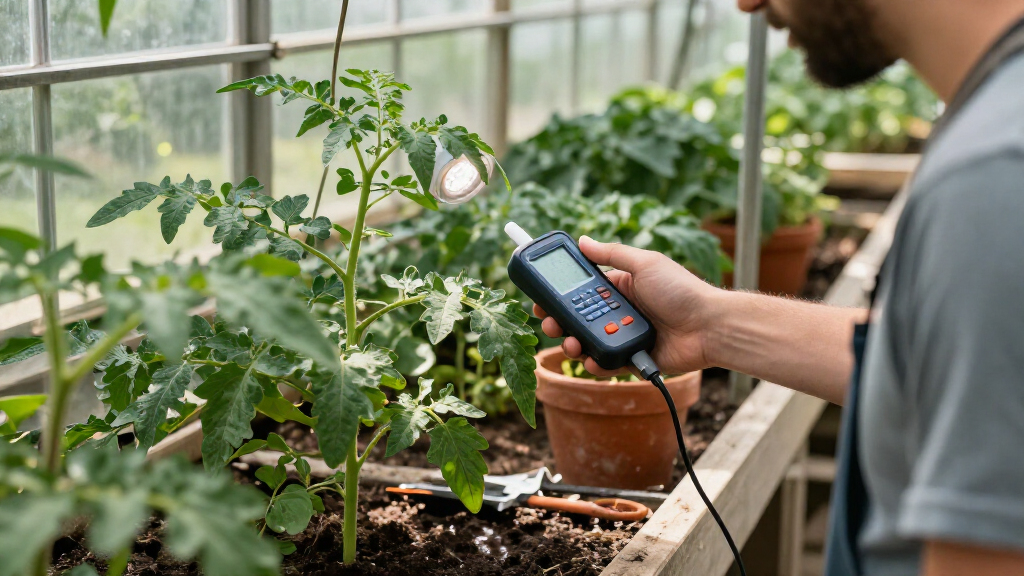

The best grow light meters depend on whether you need a straightforward PPFD reading or more detailed spectral coverage. I’d choose the Apogee MQ-610 as the best overall option here for its ePAR range, while the MQ-500 with AM-330 wand stands out for full-spectrum PAR readings and easier canopy measurements. The 3-in-1 PAR Meter suits growers who want PPFD, UVA, and infrared readings in one tool. The tradeoff is breadth versus simplicity: specialized meters can offer more useful data for a particular setup, while basic PAR meters are easier to interpret. Read on for how the eight options differ and which kind of measurement best matches your growing space.

Get garden gear delivered free with Prime
- Fast, free delivery on millions of items
- Prime Video, Amazon Music and more included
- Member-only deals all year
Complete the kit


Key Takeaways
- The Apogee MQ-610 leads for broad plant-light coverage: its 400–750 nm ePAR range extends beyond the 400–700 nm band covered by several standard PAR meters.
- The MQ-500 and AM-330 bundle prioritizes measurement access: the wand can help reach across a canopy, while the MQ-610’s standout distinction is its wider spectral range.
- Specialty meters answer narrower questions: the 3-in-1 model adds UVA and infrared readings, while the spectral meter adds UV index and flicker analysis.
- Several listings target straightforward PPFD work: the 400–700 nm Quantum PAR Meter, DANOPLUS meter, and PAR-and-lux model are better suited to growers who do not need expanded spectral analysis.
- More readouts are not automatically more useful: the right choice depends on which measurements you will act on, how you will position the sensor, and whether you need a wand or a compact handheld format.
| Apogee MQ-610 400–750 nm ePAR Quantum Meter for LED Greenhouse Grow Lights, Sunlight, and Plant Care | 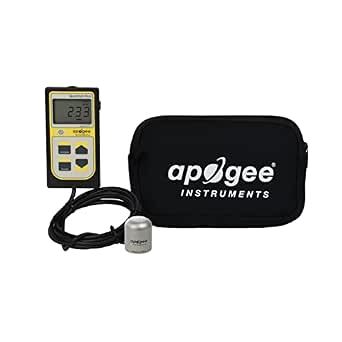 | Best for Far-Red Measurement | Wavelength range: 400–750 nm | Measurement accuracy: ±5% | Output type: Electrical signal | VIEW LATEST PRICE | See Our Full Breakdown |
| Quantum PAR Meter for LED Grow Lights, 400–700 nm |  | Best for Built-In Reading History | Model: PAR-355 | PPFD measurement range: 0–5,000 μmol/m²/s | Wavelength range: 400–700 nm | VIEW LATEST PRICE | See Our Full Breakdown |
| MQ-500 Full-Spectrum Quantum PAR Meter & AM-330 Wand Bundle |  | Best for Tall Canopies | Meter: MQ-500 | Wavelength range: 400–700 nm | Wand: AM-330 telescopic wand | VIEW LATEST PRICE | See Our Full Breakdown |
| Landtek 3-in-1 PAR Meter, PPFD/UVA/IR Light Tester 320–800 nm |  | Best for Multi-Band Light Checks | Model number: MILA53000 | Wavelength range: 320–800 nm | Wavelength tolerance: ±10 nm | VIEW LATEST PRICE | See Our Full Breakdown |
| Spectral Light Meter with PPFD, UV Index & Flicker Analysis |  | Best for Full Lighting Diagnostics | Model number: RQ-US-T7-LS330-2 | Illuminance range: 0–1,000,000 lux | Accuracy: ±3% | VIEW LATEST PRICE | See Our Full Breakdown |
| PAR Meter for Grow Lights with PPFD and Lux Measurement |  | Best for Logging PPFD and Lux Together | PPFD range: 0–5000 μmol/m²/sec | Wavelength range: 400–700 nm | Accuracy: Within ±5% of a lab-grade meter | VIEW LATEST PRICE | See Our Full Breakdown |
| AH-Quantuv PAR and UVA Meter for Grow Lights |  | Best for PAR Spectrum and UVA Checks | PAR wavelength range: 400–750 nm | UVA wavelength range: 320–400 nm | PAR spectrum breakdown: Blue, green, and red | VIEW LATEST PRICE | See Our Full Breakdown |
| DANOPLUS Quantum PAR Meter, 400–700 nm | 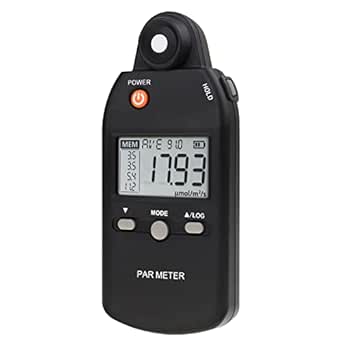 | Best for Straightforward PAR Spot Checks | Measurement range: 0–5000 μmol/m²/sec | Wavelength range: 400–700 nm | Wavelength tolerance: ±10 nm | VIEW LATEST PRICE | See Our Full Breakdown |
| grow light meter | Item weight | Wavelength range |
|---|---|---|
| Apogee MQ-610 400–750 nm ePAR | 6.4 ounces | 400–750 nm |
| Quantum PAR Meter for LED Grow | 8.8 ounces | 400–700 nm |
| MQ-500 Full-Spectrum Quantum P | 1.24 pounds | 400–700 nm |
| Landtek 3-in-1 PAR Meter | 7.5 ounces | 320–800 nm |
| Spectral Light Meter with PPFD | 8.8 ounces | — |
| PAR Meter for Grow Lights with | — | 400–700 nm |
| AH-Quantuv PAR and UVA Meter f | 6.7 ounces | — |
| DANOPLUS Quantum PAR Meter | 8.8 ounces | 400–700 nm |
More Details on Our Top Picks
Apogee MQ-610 400–750 nm ePAR Quantum Meter for LED Greenhouse Grow Lights, Sunlight, and Plant Care
The Apogee MQ-610 is the specialist pick for growers who need ePAR readings, not just conventional PAR. Its 400–750 nm range includes far-red photons that the MQ-500 and the Quantum PAR Meter for LED Grow Lights, both limited to 400–700 nm, do not capture. That broader coverage can make comparisons between lights with different far-red output more informative. A waterproof aluminum sensor head, high-contrast display, and tangle-free cable suit repeated canopy checks in greenhouse conditions. The tradeoff is that the MQ-610 provides an electrical signal output rather than a complete data-logging setup, so buyers who want stored measurement records may prefer the Quantum PAR Meter’s onboard memory. Its wider spectrum also comes at a specialist price in complexity: it makes most sense when far-red data is part of the growing decision.
Pros:- Measures through 750 nm, capturing far-red photons omitted by standard PAR meters.
- ±5% measurement accuracy is suited to careful fixture and canopy comparisons.
- Waterproof aluminum sensor head, tangle-free cable, and high-contrast display support field use.
- Four-year warranty and US-based support are useful for long-term professional work.
Cons:- Electrical signal output requires external equipment for data logging.
- Its ePAR-focused range may be unnecessary for growers who only need conventional PPFD.
- The supplied information does not specify internal measurement storage.
Best for: Greenhouse researchers and experienced growers comparing LED fixtures with meaningful far-red output across the ePAR range.
Not ideal for: Casual growers who only need standard 400–700 nm PPFD readings or want onboard storage without external data equipment.
- Wavelength range:400–750 nm
- Measurement accuracy:±5%
- Output type:Electrical signal
- Sensor head:Waterproof aluminum
- Item weight:6.4 ounces
- Cable:Tangle-free
- Warranty:Four years
Our verdict“Choose the MQ-610 when far-red measurement matters more than built-in data storage or a standard PAR-only workflow.”
Quantum PAR Meter for LED Grow Lights, 400–700 nm
The Quantum PAR Meter for LED Grow Lights is a practical choice for growers who want more than a single live reading but do not need the MQ-610’s far-red coverage or the MQ-500 bundle’s canopy wand. It measures PPFD from 0 to 5,000 μmol/m²/s across the standard 400–700 nm photosynthetic band, then calculates average, maximum, and minimum values. Its 100-reading internal storage makes it easier to compare locations or revisit a measurement session without adding a separate logger. That convenience sets it apart from the MQ-610, which outputs an electrical signal, though the Apogee model offers a wider wavelength range and a specified accuracy figure. The main compromises here are a narrower spectrum and limited published details about accuracy and durability. Two AAA batteries are required, and the listing does not say they are included.
Pros:- Measures PPFD across the standard 400–700 nm range used for conventional PAR readings.
- 0–5,000 μmol/m²/s range covers a broad span of grow-light intensities.
- Stores up to 100 readings internally.
- Average, maximum, and minimum calculations help summarize uneven canopy measurements.
Cons:- Does not measure beyond 700 nm, unlike the Apogee MQ-610.
- Two AAA batteries are required and are not specified as included.
- The supplied product data does not state measurement accuracy or sensor construction.
Best for: Home growers and small grow-room operators who want to save and compare multiple standard-band PPFD readings without external logging gear.
Not ideal for: Researchers needing documented measurement accuracy, far-red readings, or a rugged waterproof sensor for demanding field work.
- Model:PAR-355
- PPFD measurement range:0–5,000 μmol/m²/s
- Wavelength range:400–700 nm
- Data functions:Average, maximum, and minimum
- Measurement storage:Up to 100 values
- Display:Large display
- Batteries:2 AAA batteries required
- Item weight:8.8 ounces
Our verdict“Pick this meter if built-in storage and quick PPFD summaries matter more to you than extended spectrum coverage or documented ruggedness.”
MQ-500 Full-Spectrum Quantum PAR Meter & AM-330 Wand Bundle
The MQ-500 with AM-330 wand earns its place for growers who need to take readings above shoulder height or across hard-to-reach canopy areas. The telescopic wand extends to 36.25 inches, reducing the need to move plants or reach between fixtures; neither the MQ-610 nor the compact Quantum PAR Meter bundle includes that access advantage in the supplied product details. Its waterproof, machined-aluminum sensor head measures the standard 400–700 nm PPFD band, making it a durable field option, though it does not capture the far-red range of the MQ-610. A tangle-free cable and high-contrast display also suit repeated greenhouse checks. The bundle is heavier and bulkier than a handheld meter, and its fixed wand reach may not fit every setup. The supplied data also does not specify a PPFD range or accuracy figure.
Pros:- AM-330 wand extends to 36.25 inches for readings over tall or dense canopies.
- Waterproof, machined-aluminum sensor head is suited to field conditions.
- Measures PPFD across the 400–700 nm photosynthetic spectrum.
- Tangle-free cable and high-contrast display support easier data collection.
Cons:- The bundle weighs 1.24 pounds and has larger package dimensions than a simple handheld meter.
- The wand reach is fixed at the stated extension, with other lengths requiring additional accessories.
- The supplied product data does not list measurement accuracy or PPFD range.
Best for: Greenhouse staff and indoor growers measuring light across tall, dense, or difficult-to-reach plant canopies.
Not ideal for: Growers with low, accessible shelves who want a compact meter, or researchers who need far-red readings beyond 700 nm.
- Meter:MQ-500
- Wavelength range:400–700 nm
- Wand:AM-330 telescopic wand
- Maximum wand extension:36.25 inches
- Sensor head:Machined aluminum, fully potted, waterproof
- Item weight:1.24 pounds
- Batteries:1 lithium metal battery, included
- Package dimensions:14.61 × 4.53 × 4.25 inches
Our verdict“Choose this bundle when canopy access is your main challenge and standard PAR readings are sufficient.”
Landtek 3-in-1 PAR Meter, PPFD/UVA/IR Light Tester 320–800 nm
The Landtek 3-in-1 PAR Meter suits growers who want to check more than PPFD without carrying separate instruments. Its 320–800 nm coverage includes UVA and infrared readings alongside PAR, while MAX/MIN/AVERAGE calculations and storage for 30 records help summarize checks across a grow space. A built-in tripod socket supports stable positioning, unlike the MQ-500 bundle, which instead prioritizes reaching high canopies with its wand. The Landtek’s RGB spectroradiometer adds spectral detail, but its stated wavelength tolerance is ±10 nm, and the 800 nm ceiling still falls short of the MQ-610’s 750 nm ePAR range for far-red work only in the sense that it extends differently: it covers wider UV/IR bands but is not a substitute for a dedicated ePAR measurement specification. Two included AAA batteries are convenient; a tripod is not included.
Pros:- Measures PPFD, UVA, and IR across a broad 320–800 nm range.
- MAX/MIN/AVERAGE functions and storage for up to 30 records support comparisons.
- RGB spectroradiometer provides additional spectral information.
- Built-in tripod socket allows handheld or mounted use.
Cons:- The ±10 nm wavelength tolerance may not suit highly exacting spectral work.
- Tripod is not included, despite the built-in mounting socket.
- Its 800 nm upper limit does not cover wavelengths beyond that range.
Best for: Growers checking PPFD alongside UVA and near-infrared output, especially when they want to mount the meter for repeatable readings.
Not ideal for: Buyers who need a dedicated ePAR instrument with a defined far-red measurement range or a ready-to-use tripod setup.
- Model number:MILA53000
- Wavelength range:320–800 nm
- Wavelength tolerance:±10 nm
- PPFD range:0–5,000 μmol/m²·s
- Measurement modes:PPFD, UVA, and IR
- Data functions:MAX, MIN, and AVERAGE
- Record storage:Up to 30 records
- Batteries:2 AAA batteries, included
- Item weight:7.5 ounces
Our verdict“Choose the Landtek when one handheld instrument for PPFD, UVA, and IR is more useful than a specialized ePAR meter or canopy wand.”
Spectral Light Meter with PPFD, UV Index & Flicker Analysis
This spectral light meter is the broadest diagnostic tool in the group, aimed at growers who want plant-light readings plus information about the lighting environment. Its plant mode includes PPFD, blue/green/red PPFD, YPFD, and chlorophyll A/B, while other functions cover UV index, flicker, color temperature, CRI, temperature, and humidity. That feature range goes well beyond the MQ-500’s focused 400–700 nm PPFD measurements, but it also creates a steeper learning curve than the Quantum PAR Meter’s straightforward average, maximum, and minimum readings. A response time under 0.7 seconds and real-time spectral curves support quick checks, though the supplied data does not give a PPFD range or accuracy specification for those plant-mode readings. AA battery power and the extensive feature set make this a better fit for technically curious growers than for simple canopy mapping.
Pros:- Plant mode reports PPFD, blue/green/red PPFD, YPFD, and chlorophyll A/B.
- Combines grow-light readings with UV index, flicker, color, temperature, and humidity functions.
- Response time is under 0.7 seconds.
- Real-time spectral curves and data logging support broader light analysis.
Cons:- The feature set may be difficult to use efficiently for basic PPFD checks.
- AA batteries are required for operation.
- The supplied product data does not specify the PPFD measurement range or accuracy.
Best for: Indoor-farm operators and lighting technicians who need plant metrics alongside flicker, UV, color, temperature, and humidity diagnostics.
Not ideal for: First-time growers seeking a simple PPFD meter, or buyers who need a clearly specified PPFD range and accuracy before purchase.
- Model number:RQ-US-T7-LS330-2
- Illuminance range:0–1,000,000 lux
- Accuracy:±3%
- Response time:<0.7 seconds
- Color temperature range:1,000–100,000 K
- Power source:AA batteries
- Package dimensions:8.78 × 4.41 × 1.89 inches
- Item weight:8.8 ounces
Our verdict“Choose this meter when you need broad lighting diagnostics beyond PPFD and are prepared to work through a more complex feature set.”
PAR Meter for Grow Lights with PPFD and Lux Measurement
The L:andtek MILA35500 suits growers who want both plant-focused PPFD readings and familiar lux or foot-candle measurements in one handheld tool. Its 400–700 nm range covers standard PAR, while the 100-reading memory and minimum, maximum, and average calculations help compare brighter and dimmer spots across a grow area. That makes it more useful for mapping than a basic meter without logging. Compared with the DANOPLUS Quantum PAR Meter, it adds lux and foot-candle modes plus summary calculations; DANOPLUS instead shows the four latest readings at a glance. The stated ±5% accuracy is a useful reference, though growers needing a broader spectrum should look at an ePAR option such as the Apogee MQ-610. The tradeoffs are AAA battery dependence and a three-minute automatic shutoff that can interrupt longer measurement sessions.
Pros:- Measures PPFD alongside lux and foot-candles for both plant-light and visible-light checks.
- Stores up to 100 readings across four sets and calculates minimum, maximum, and average.
- A 1/4-inch thread allows stable tripod or selfie-stick mounting.
- Compact 7-ounce handheld body is easy to move between plants.
Cons:- Requires two AAA batteries, so spare batteries may be needed during extended work.
- Automatic shutoff after three minutes can interrupt measurements if the user pauses.
- The 400–700 nm range does not cover UVA or far-red wavelengths.
Best for: Indoor growers who want to map PPFD while also checking lux or foot-candles, especially when comparing several canopy positions.
Not ideal for: Growers measuring beyond 700 nm or anyone who wants to leave the meter running through a long mapping session without automatic shutoff.
- PPFD range:0–5000 μmol/m²/sec
- Wavelength range:400–700 nm
- Accuracy:Within ±5% of a lab-grade meter
- Illuminance ranges:0.1–200,000 lux; 0.01–20,000 foot-candles
- Data logging:100 readings across 4 sets
- Calculations and controls:Minimum, maximum, and average; hold function
- Mounting:1/4-inch thread
- Power and size:2 AAA batteries included; 7.4 × 3.6 × 1.8 inches; 7 ounces
Our verdict“Choose the MILA35500 if you want logged PPFD mapping plus lux and foot-candle readings in one compact meter.”
AH-Quantuv PAR and UVA Meter for Grow Lights
The AH-Quantuv is the most specialized pick here: it measures UVA irradiance as well as PAR and separates PAR readings into blue, green, and red contributions. That extra spectral detail can help growers compare fixtures or evaluate whether a setup delivers the wavelengths they intend, rather than relying on a single total. Its 400–750 nm PAR range also extends past the standard 400–700 nm coverage of the DANOPLUS Quantum PAR Meter. The AH-Quantuv records up to 100 PAR measurements and offers multiple display modes, but the supplied details do not specify a PPFD range or accuracy figure, so buyers seeking those benchmarks should compare it with the L:andtek MILA35500, which states both. Recording is limited to PAR measurements, and two AAA batteries are required.
Pros:- Measures UVA irradiance across 320–400 nm in addition to PAR.
- Displays separate blue, green, and red PAR contributions for more spectral context.
- Records up to 100 PAR measurements for mapping light distribution.
- Multiple display modes and a hold function support point-by-point checks.
Cons:- The provided specifications do not state a measurement range in PPFD or an accuracy figure.
- Recording capacity is specified for PAR measurements, not UVA readings.
- Requires two AAA batteries.
Best for: Growers comparing LED spectrum and UVA output who want separate blue, green, and red PAR readings alongside stored PAR measurements.
Not ideal for: Buyers who need a stated PPFD range or accuracy specification, or who want recorded UVA readings rather than UVA measurement alone.
- PAR wavelength range:400–750 nm
- UVA wavelength range:320–400 nm
- PAR spectrum breakdown:Blue, green, and red
- Measurement recording:Up to 100 PAR measurements
- Display and controls:Multiple display modes; hold function
- Power:2 AAA batteries included
- Item weight:6.7 ounces
- Manufacturer and model:De-Power; AH-Quantuv
Our verdict“Pick the AH-Quantuv when UVA and color-band detail matter more than clearly stated PPFD range and accuracy specifications.”
DANOPLUS Quantum PAR Meter, 400–700 nm
The DANOPLUS DP-355 keeps the job focused: it measures PAR from 0–5000 μmol/m²/sec across the standard 400–700 nm band, stores up to 100 readings, and keeps the latest four visible. That recent-reading display is handy when checking several canopy points in sequence, without the broader calculation and illuminance features found on the L:andtek MILA35500. A tripod socket helps hold the sensor steady, which can make repeat measurements easier, but the tripod itself is not included. Its listed wavelength tolerance is ±10 nm, and the product details do not provide an accuracy percentage, so it is less fully specified for buyers comparing measurement confidence. Unlike the AH-Quantuv, it does not add UVA or separate color-band readings; its appeal is a compact, conventional PAR meter for routine spot checks.
Pros:- Measures 0–5000 μmol/m²/sec across the standard 400–700 nm PAR band.
- Stores up to 100 measurements and displays the four most recent.
- Tripod socket supports steady positioning for repeat spot checks.
- Portable 8.8-ounce design is suited to moving around a grow space.
Cons:- A tripod is not included, despite the socket for mounting one.
- The listed wavelength tolerance is ±10 nm, and no accuracy percentage is provided.
- Does not measure lux, UVA, or separate blue, green, and red PAR contributions.
Best for: Home growers who want a portable, standard-range PAR meter for checking canopy locations and reviewing recent readings.
Not ideal for: Growers who need UVA or spectral color breakdowns, want lux measurements, or require a stated accuracy percentage.
- Measurement range:0–5000 μmol/m²/sec
- Wavelength range:400–700 nm
- Wavelength tolerance:±10 nm
- Data storage:Up to 100 measurements
- Recent readings display:Last 4 measurements
- Mounting:Tripod socket; tripod not included
- Item weight:8.8 ounces
- Manufacturer and model:DANOPLUS; DP-355
Our verdict“Choose the DP-355 for uncomplicated PAR spot checks and recent-reading access, but skip it if you need spectral extras or documented accuracy.”
How We Picked
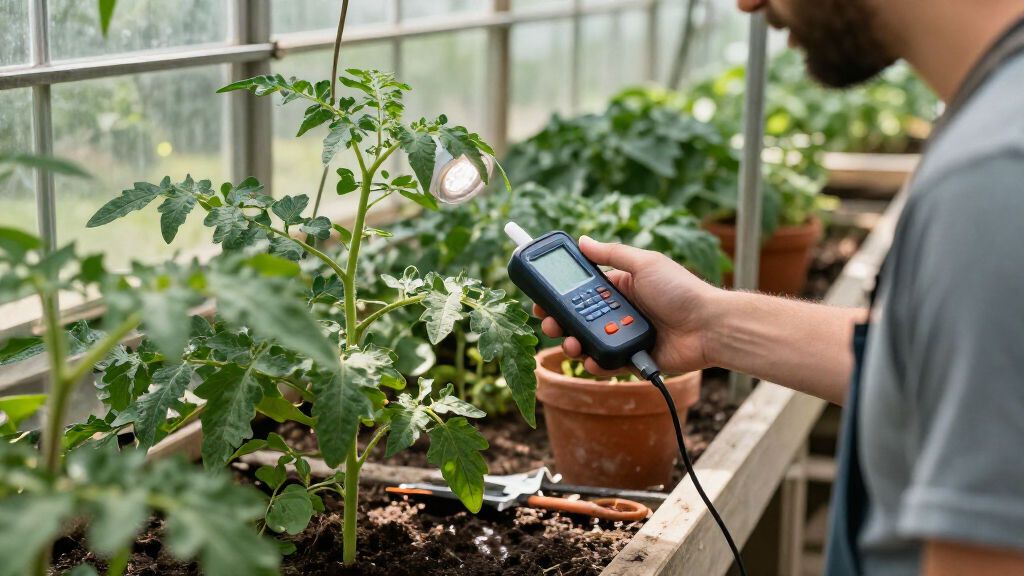
I compared these meters by the measurements they claim to provide, the spectral ranges stated in their names, and how their features map to common grow-room decisions. A PPFD-focused meter can help check light intensity at plant level; expanded ePAR, UVA, or infrared readings may matter to growers with more specific measurement needs. I also looked at practical differences such as a wand bundle, combined lux readings, and added spectral or flicker analysis.
The ranking favors tools with a clear advantage for plant-light measurement, useful coverage, or easier readings across a canopy. That places the Apogee MQ-610 first for its stated ePAR range and the MQ-500 bundle high for its full-spectrum PAR focus and wand. Models with extra measurements are ranked for buyers who will use those readings, not simply because their feature lists are longer. Where product names provide limited detail about accuracy, calibration, display, or durability, I avoid treating those qualities as established advantages.
Factors to Consider When Choosing Best Grow Light Meters
Before choosing a meter, decide what decision you want its readings to support. The distinctions below can help prevent paying for measurements you will not use—or relying on a meter that does not cover the light your setup produces.
Match the Spectral Range to Your Lighting Question
A 400–700 nm PAR meter measures the traditional photosynthetically active range and can be a practical fit for checking PPFD from many grow lights. A meter listing a wider range, such as ePAR coverage to 750 nm, may be more relevant when you want readings beyond that traditional band. Do not assume a wider stated range automatically makes one meter more accurate or more useful for every plant. First check which wavelengths your fixtures emit and what the meter’s documentation says it measures. A common mistake is comparing readings from meters with different spectral coverage as if they were interchangeable. Use one consistent measurement approach when tracking changes to your lighting setup.
Know Which Reading You Need: PPFD, DLI, Lux, or Spectrum
PPFD describes the amount of photosynthetic light reaching a surface at a moment, making it useful for mapping light across a canopy. DLI reflects the accumulated light plants receive over a day, so it depends on intensity and photoperiod rather than a single spot reading. Lux is weighted for human vision and should not be treated as a direct substitute for PPFD, especially across different light spectra. Spectral, UV, or flicker readings answer separate questions and may add value when you are comparing fixture characteristics or investigating a particular setup. Before buying, list the readings you will actually use and check that the meter reports them directly. This keeps extra functions from obscuring the measurement you need most.
Plan How You Will Sample the Canopy
One reading at the center of a grow area cannot show whether the edges receive much less light. A useful check involves taking measurements at several positions and heights, then comparing the pattern rather than relying on one number. A wand can make it easier to position a sensor over a broad or hard-to-reach canopy, but it may add bulk compared with a compact handheld meter. Consider the size of your growing area, the height of your fixtures, and whether you need to measure beneath foliage. Keep sensor orientation and distance consistent between readings so changes reflect the setup rather than your technique. For small shelves, a simpler handheld design may be easier to store and use.
Treat Accuracy and Calibration as Separate Buying Questions
A meter’s stated wavelength range does not tell you how closely its readings match a reference or how it behaves under every LED spectrum. Look for manufacturer information on calibration, stated accuracy, sensor response, and supported light sources before relying on readings for fine adjustments. If that information is missing from a listing, consult the product documentation rather than inferring performance from a feature name. Calibration matters most when you need repeatable readings over time or want to compare different fixtures. For routine relative checks—such as finding uneven spots under one light—consistency in your method may be more useful than chasing a precise-looking display. Do not compare two meters as though their numbers must match unless their measurement methods and specifications support that comparison.
Pay for Extra Features Only When They Change a Decision
UVA, infrared, UV-index, color-temperature, CRI, and flicker functions can be useful, but each serves a different purpose from basic PPFD measurement. A grower adjusting light intensity may get more value from clear, repeatable PPFD readings than from a long list of rarely used metrics. Specialty readings make more sense when you already have a specific question about a fixture or environment that those readings can answer. Check whether the meter reports those values in a way you can interpret and act on. More functions can also mean more settings to learn, so consider who will use the meter and how often. Prioritize the measurement workflow first, then choose extra capabilities that support it.
Check the Handling and Documentation Before You Commit
Grow-room measurements often involve repeated trips between plants, fixtures, and a notebook or app, so readable controls and a manageable sensor shape matter. A bundled wand can improve reach, while a compact meter can suit quick checks in a small tent or propagation area. Confirm what comes in the package and whether the sensor, cable, case, or accessories meet your workflow; do not infer bundle details from a product name alone. Review the manual for operating instructions, care guidance, and any limits on measurement conditions. If more than one person will use the meter, straightforward setup and consistent procedures can reduce mismatched readings. Favor a tool you can use correctly every time over one whose extra functions remain unexplored.
Frequently Asked Questions
Is a 400–700 nm PAR meter enough for a home grow room?
It can be enough if your main task is checking PPFD under your fixtures and you do not need readings outside the traditional PAR band. The Quantum PAR Meter and DANOPLUS model are listed for 400–700 nm, which makes that limitation clear from their names. If you want to measure an expanded range, compare them with the Apogee MQ-610’s stated 400–750 nm ePAR coverage. The wider range is not automatically necessary for every setup. Check your fixture’s spectral output and the meter documentation before deciding that standard PAR coverage is insufficient.
Should I choose the MQ-610 or the MQ-500 with AM-330 wand?
Choose based on the difference that matters most to your measurements. The MQ-610 is distinguished by its stated 400–750 nm ePAR range, while the MQ-500 bundle is described as a full-spectrum PAR meter supplied with an AM-330 wand. The wand may be more useful when you need to reach across a wide canopy or take readings at awkward positions. The MQ-610 is the clearer match if expanded ePAR coverage is your priority. Check the current product documentation for exact measurement specifications and bundle contents before choosing between them.
Do I need a meter that measures UVA or infrared?
Only if those measurements answer a question you have about your lighting setup. The 3-in-1 model lists PPFD, UVA, and infrared readings, and the AH-Quantuv is specifically named for PAR and UVA. Those functions do not replace checking whether the meter reports the PPFD information you need. If your main goal is to map light intensity across plants, a dedicated PAR-focused tool may be simpler to interpret. Choose added spectral readings when you have a clear plan for using them, rather than treating them as a general upgrade.
Can I use lux readings to set grow-light intensity?
Lux can help compare brightness readings from the same light under consistent conditions, but it is weighted for human vision and is not the same measurement as PPFD. Differences in a fixture’s spectrum can make lux a poor basis for comparing plant-usable light across different lights. The PAR-and-lux model may suit someone who wants both kinds of readings, but the lux function should not be mistaken for a PPFD measurement. If plant-light intensity is your goal, prioritize a meter that explicitly reports PPFD. Use lux as a supplementary reading only when its limits fit your comparison.
Is a meter with UV and flicker analysis worth choosing over a simpler PAR meter?
It depends on whether you will use those additional measurements. The spectral light meter listing includes PPFD, UV index, and flicker analysis, along with lux, color temperature, and CRI; that breadth may appeal to buyers examining more than plant-light intensity. A simpler PAR meter may be easier to operate when you only want to check PPFD across a canopy. Extra readouts do not by themselves establish better accuracy for the measurement you care about. Compare the specifications and instructions for each function, then choose the device whose readings inform decisions you actually plan to make.
Conclusion
For the broadest plant-light measurement scope in this lineup, I’d pick the Apogee MQ-610 as best overall for its stated 400–750 nm ePAR range. The best premium-style choice for canopy access is the MQ-500 with AM-330 wand if reaching across a growing area matters more than the MQ-610’s wider stated range. For best value on straightforward PAR checks, compare the 400–700 nm Quantum PAR Meter and DANOPLUS meter by their documentation and handling, since their listed ranges alone do not establish a performance difference. Beginners who want a simple PPFD-focused starting point should favor a clearly documented basic PAR meter over specialty readouts they will not use. If you need specific extra measurements, choose the 3-in-1 for PPFD, UVA, and infrared, or the spectral meter for its listed UV index and flicker analysis; match those features to a real measurement need.