
TL;DR

Get garden gear delivered free with Prime
- Fast, free delivery on millions of items
- Prime Video, Amazon Music and more included
- Member-only deals all year
IdeaClyst acts as a digital war room, providing a structured environment for testing, discovering, and refining ideas using AI, all stored locally on your machine. It helps founders avoid costly mistakes by grounding decisions in real research and structured debate.
Imagine having a dedicated, high-stakes war room for your next idea—where every detail gets scrutinized, debated, and refined. Now, picture doing that on your own laptop, with no cloud, no subscription, no data leaks. That’s the promise of IdeaClyst.
In a world where building the wrong thing can cost over $150,000 in six months, founders need a sharper edge. This isn’t just about brainstorming; it’s about making confident, evidence-backed decisions fast. Let’s peek inside what makes IdeaClyst a game-changer for your idea process.
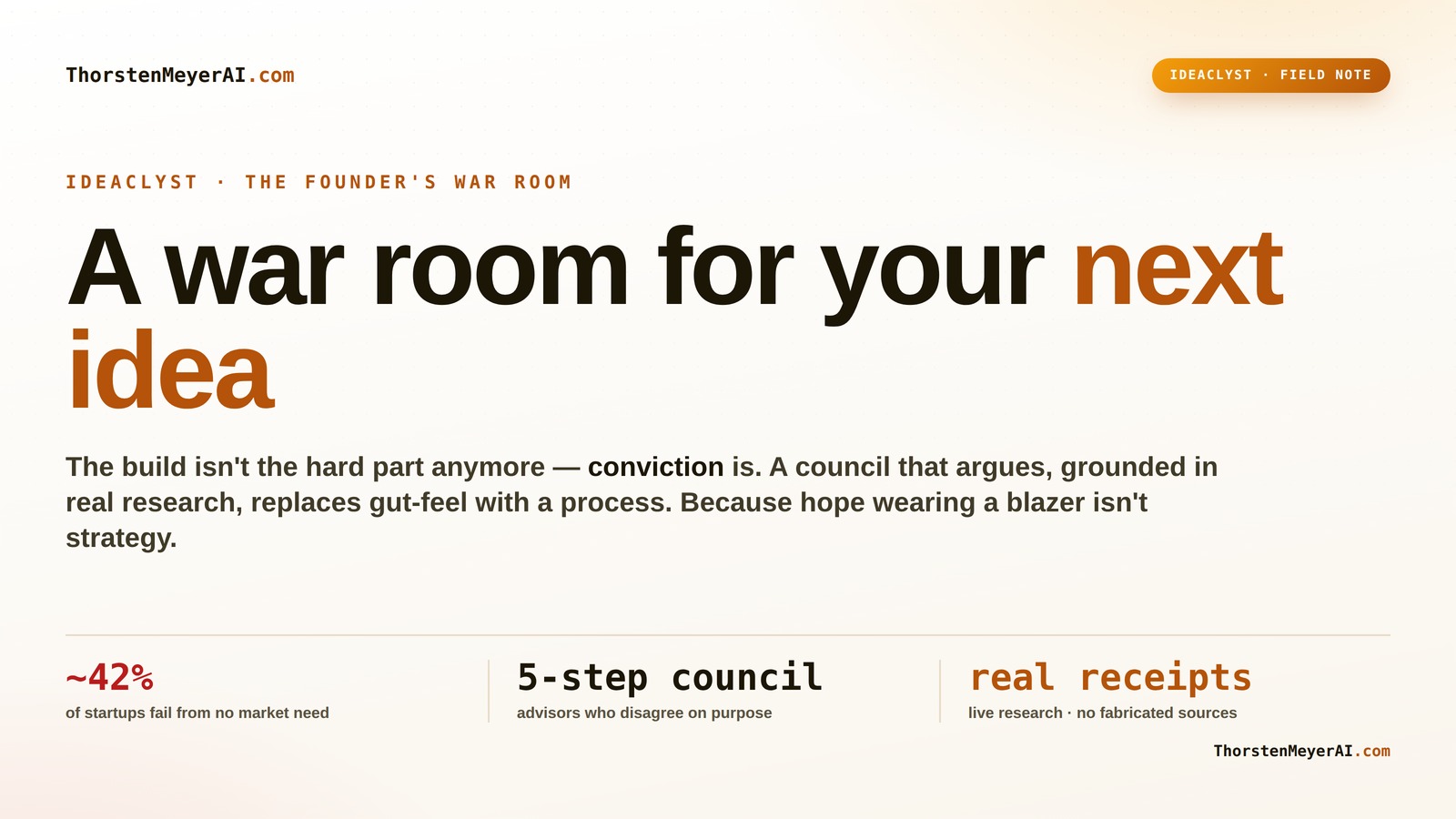
A war room for your next idea
The build isn’t the hard part anymore — conviction is. Knowing which idea deserves the next six months, and being able to defend it. Most founders answer with gut feel and optimistic math. That’s hope wearing a blazer. IdeaClyst replaces it with a process.
The most expensive decision is what to build
The single most valuable thing a tool can do is talk you out of the wrong six months. The numbers make the case better than any pitch.
Three tools in one — on your own machine
Strip away the framing and IdeaClyst is three things at once, all running locally with nothing leaving your laptop.
An AI council
Pressure-tests an idea you bring it — advisors who argue on purpose.
A discovery engine
Finds ideas you didn’t know to look for by hunting real demand signals.
A founder’s workspace
Carries winners from “interesting” all the way to “ready to build.”
Advisors who disagree on purpose
Not one confident, agreeable answer — a structured five-step deliberation where models play different roles and turn on their own work. The disagreement is the feature.
The five-step deliberation
A council that leads with the bad news surfaces the objections you’d otherwise find the expensive way, on month five.
Product strategy
Who’s it for, what’s the wedge, why now, what’s the business model.
Technical architecture
What would it actually take to build — and where’s the risk.
Critique pass
The council turns on its own work. Where’s the hand-waving? What kills this?
Second, independent critique
A different voice, a different angle — so blind spots don’t survive.
Final synthesis
Everything into one coherent founder packet: strategy, architecture, validation, plan.
When IdeaClyst cites a source, it actually fetched it
The hard departure from “ask an AI what it thinks of my startup.” It runs in a strict, real-data-only mode — if it can’t gather genuine evidence, it says so plainly rather than inventing a plausible paragraph.
Confidence with receipts
No fabricated statistics, no imaginary competitors, no made-up citations. The packet survives a skeptical co-founder or a sharp investor because the reasoning has receipts.
Market research first
Scouts the landscape before the council reasons about anything.
Competitor read
Real positioning, pricing signals, feature claims — differentiation vs. reality.
Validation with links
Not “talk to customers” — concrete signals & sources you can click.
From the blank page to build-ready
Evaluation is half the problem; the blank page is the other half. And a plan is worthless if it dies in a tab you never reopen.
Bring a space, not an idea
“AI for accountants,” “tools for indie game studios” — plus your goal and real capacity. It hunts demand signals across HN, Reddit, Product Hunt, GitHub, pricing pages.
- An honest market read — leads with the bad news when a space is hard
- An opportunity map — high pain, thin competition
- Ranked candidates — wedge, who pays, effort, risk, confidence
- each with KILL CRITERIA — when to walk away
A home and a forward path
Every promising idea gets carried forward, with every artifact in plain files on your disk.
- Validation tooling — sprint board, interview list, evidence browser
- Founder profile — a personal-fit lens; same discovery, different advice
- Build workspaces — funnel, personas, landing draft, version history
- “Build this idea” → a PRD + task queue, ready for a coding agent
Key Takeaways
- IdeaClyst turns your laptop into a local, AI-powered war room—no cloud, no data leaks.
- Its structured council debates expose weaknesses early, saving thousands in costly mistakes.
- Grounding advice in live web research ensures your decisions are evidence-based.
- Regular reviews keep your idea pipeline fresh and actionable.
- Encouraging team buy-in turns your war room into a central hub for strategic growth.
portable AI-powered laptop war room software
As an affiliate, we earn on qualifying purchases.
As an affiliate, we earn on qualifying purchases.
What Exactly Is a War Room for Ideas? You’ll Be Surprised
A war room for ideas is more than just a whiteboard or a Slack channel. It’s a dedicated space—physical or digital—where your team can gather, see progress, and make decisions in real-time. Think of it as your project’s nervous system, keeping everyone aligned and engaged.
For example, some startups set up a physical war room with sticky notes, charts, and prototypes on the walls. Others prefer a shared online dashboard where ideas are tracked from brainstorm to launch. The core goal: visibility and momentum, regardless of space.
This concept is vital because it keeps ideas alive and evolving. It’s not just a one-off session; it’s a continuous, organized hub that makes sure no idea gets lost or forgotten.
Having a dedicated war room enhances focus and accountability. When everyone knows that their ideas and efforts are documented and visible, it encourages more thoughtful contributions. It also helps prevent siloed thinking, ensuring that insights from different team members or stakeholders are integrated seamlessly. The tradeoff is that maintaining such a space requires discipline and consistent updating, but the payoff is a more agile, aligned team that can pivot quickly based on collective insights.
How Does IdeaClyst Turn Your Laptop Into a War Room?
IdeaClyst transforms your local machine into a digital war room—no cloud needed. You input your idea, and it runs a five-step debate among AI models acting as advisors with different roles. These models challenge, critique, and refine your concept.
For example, you might start with a half-formed idea like, “A new SaaS for remote teams.” The AI council then probes who it’s for, how to build it, what risks exist, and whether it’s worth pursuing. The outcome is a comprehensive, Markdown-formatted report stored right on your disk.
This setup prevents data leaks and gives you full control, while still leveraging AI’s powerful insights. Plus, it’s open source—your ideas stay yours, safely tucked inside your machine.
Deep integration of AI in your idea validation process means you can iterate rapidly without waiting for external feedback or risking data breaches. The tradeoff is that you need to understand how to interpret AI-generated critiques and sometimes manually refine inputs. This approach emphasizes control and privacy, but it requires a bit more active engagement from you as the founder.
The AI Council: Why Disagreement Is Your Secret Weapon
Instead of a single AI giving you a lukewarm yes or no, IdeaClyst stages a structured debate among different models—each playing a role. One argues the product market fit, another the technical risks, and two critique from different angles.
For instance, the product strategist might emphasize market size, while the architecture advisor flags potential tech bottlenecks. The final step synthesizes these into a founder-friendly report, highlighting strengths and weaknesses.
This disagreement isn’t chaos; it’s your best defense against costly mistakes. It surfaces objections early, so you can pivot or refine before spending months and thousands of dollars.
By fostering diverse viewpoints, the AI council helps you identify blind spots that might otherwise be overlooked. The tradeoff is that managing multiple perspectives can sometimes lead to conflicting advice, requiring the founder to interpret and prioritize critiques thoughtfully. This process encourages a deeper understanding of the nuances behind each recommendation, ultimately leading to more robust decision-making.
Grounded in Real Research—Not Just Model Vibes. You can learn more about how to leverage real-world data for better decision-making.
Unlike generic AI prompts that confidently spew vague market trends, IdeaClyst anchors its advice in real-time web research. It pulls fresh data, news, and stats to back up every critique and recommendation.
For example, if you propose a telehealth app, the AI checks current adoption rates, regulatory changes, and competitor moves—based on live sources. This grounding makes your decisions evidence-backed, not guesswork.
According to industry data, 42% of startup failures come from building something nobody needs. AI tools that integrate live research can cut this risk significantly—by providing up-to-date, concrete insights.
This approach ensures your ideas are not based on outdated assumptions or biased perceptions. The implications are profound: you can confidently prioritize features, target markets, and partnerships with real data, reducing the guesswork that often leads to failure. The tradeoff is that live data integration may require you to verify and interpret the AI’s findings critically, as no automated system is perfect. Still, grounding your decisions in current, real-world information dramatically improves your odds of success.
Learn more about IdeaClyst..Frequently Asked Questions
Is IdeaClyst suitable for solo founders?
Absolutely. IdeaClyst is designed to be a personal war room, helping solo founders validate ideas quickly without external cloud services. It’s especially valuable when you want full control over your data.Can I use IdeaClyst for ongoing projects?
Yes. Its structure encourages continuous refinement. Regularly update your reports, critique new ideas, and keep your strategic plan current—making it a living document for your project’s lifecycle.How effective is IdeaClyst compared to traditional market research?
While it doesn’t replace direct customer feedback, IdeaClyst compresses months of research into hours by pulling in live data and surfacing critical objections early. It’s a powerful tool for initial validation and risk reduction.Does IdeaClyst support team collaboration?
Primarily, it’s built for individual use on your machine. However, you can share reports and files with your team, and it can integrate into broader workflows—especially when combined with collaborative tools.Conclusion
In a landscape flooded with ideas, your best move is to create a dedicated, disciplined space where your concepts are challenged, refined, and validated. IdeaClyst offers that space—on your own machine, with AI as your skeptical yet constructive partner.
Treat your idea war room as the backbone of your decision-making. With it, every choice becomes a calculated step, not a leap in the dark. Because in the end, your next big idea deserves a battlefield where it can succeed.
Halloween Picks
halloween
As an affiliate, we earn on qualifying purchases.