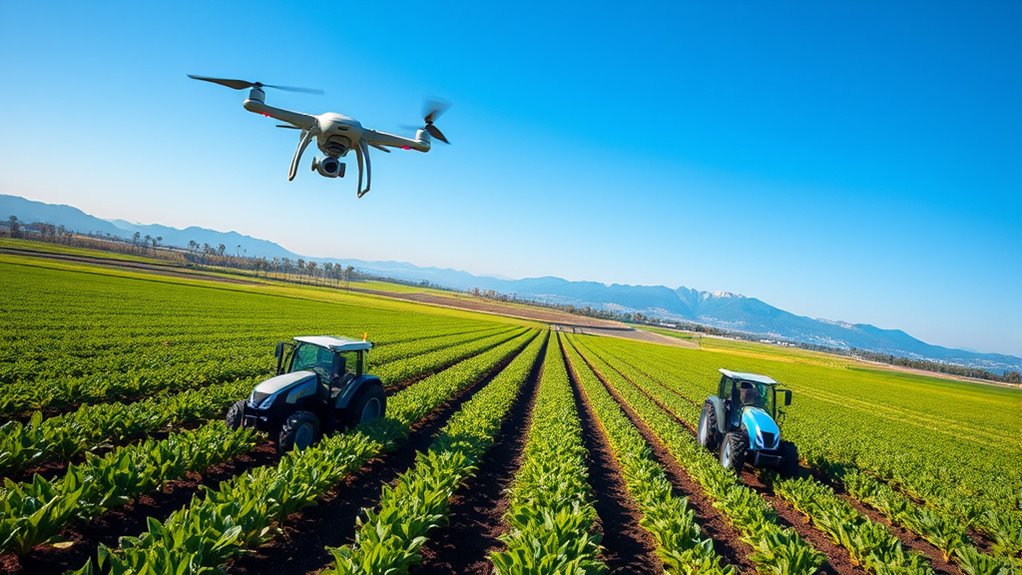
Agricultural robotics like self-driving tractors and drones are transforming farming by increasing efficiency, precision, and sustainability. You can rely on autonomous machines to handle tasks such as planting, fertilizing, and monitoring crops around the clock. Drones equipped with multispectral cameras quickly survey fields, helping you detect pests and diseases early. As these innovations optimize resource use and boost yields, exploring further reveals how they can make your farm smarter and more productive.

Get garden gear delivered free with Prime
- Fast, free delivery on millions of items
- Prime Video, Amazon Music and more included
- Member-only deals all year
Key Takeaways
- Self-driving tractors automate tillage, planting, and fertilization, increasing efficiency and reducing labor costs.
- Drones equipped with multispectral cameras enable rapid, detailed crop monitoring for early detection of issues.
- Precision robotics optimize seed placement and resource application, promoting sustainable farming practices.
- Automated systems operate continuously, enhancing operational speed and enabling remote farm management.
- Integration of robotics reduces environmental impact by precise use of water, fertilizers, and pesticides.

Agricultural robotics is transforming farming by introducing intelligent machines that perform tasks more efficiently and precisely than traditional methods. These innovations, including self-driving tractors and drones, are revolutionizing how you manage your fields and crops. With robotic technology, crop monitoring becomes more accurate, allowing you to detect issues like pests, diseases, or nutrient deficiencies early. Instead of relying solely on manual inspections, you can deploy drones equipped with multispectral cameras to survey your fields quickly and gather detailed data. This enables you to make informed decisions, improving yield quality and reducing input costs. Incorporating active listening and empathy into your management approach can further enhance decision-making and team coordination on your farm.
Agricultural robotics enhances efficiency and precision in farming through smart machines like drones and autonomous tractors.
Precision planting is another area where robotics make a significant impact. Traditional planting methods often involve guesswork, leading to uneven seed distribution and subpar crop growth. Now, with autonomous machinery, you can ensure each seed is planted at the ideal depth and spacing. Self-driving planters equipped with GPS and sensor technology adjust their movements in real time, adapting to variations in soil conditions. This level of accuracy not only boosts germination rates but also minimizes seed wastage, making your planting process more sustainable and cost-effective. The integration of robotics in planting tasks means fewer overlaps, better resource use, and healthier crops from the start.
By incorporating these robotic tools, you gain better control over your farm’s productivity. Drones can perform frequent crop health assessments, providing you with up-to-date information that helps you target problem areas more efficiently. This rapid response capability minimizes crop loss and maximizes your harvest potential. Meanwhile, autonomous tractors handle tillage, fertilization, and planting with minimal human intervention, freeing you to focus on strategic planning or other farm management tasks. These machines work tirelessly, often operating 24/7, which accelerates your farming cycle and increases overall efficiency.
Furthermore, these technological advances are designed to integrate seamlessly into your existing farm operations. Data collected from drones and sensors feed into centralized systems, giving you a broad view of your farm’s health and productivity. You can schedule and control operations remotely, ensuring consistency and accuracy across large areas. As a result, you’re empowered to optimize inputs like water, fertilizer, and pesticides, reducing waste and environmental impact while boosting crop yields. Overall, adopting agricultural robotics means transforming your farm into a smarter, more productive operation where precision and automation lead to better results.
Popular right now

Vitamix Propel Series 750 Professional-Grade Blender, 4 Programs, Black

Vitamix Propel Series 510 Professional-Grade Blender, 3 Programs, Black

Bose QuietComfort Wireless Noise-Cancelling Over-Ear Headphones, Black
As an affiliate, we earn on qualifying purchases.
Frequently Asked Questions
What Are the Safety Protocols for Agricultural Robots?
You should follow strict robot safety and protocol standards to guarantee safe operation of agricultural robots. Always conduct thorough risk assessments before deployment, keep a safe distance during robot operation, and use emergency stop functions if needed. Regular maintenance and calibration are vital to prevent malfunction, and training is essential for operators to understand safety procedures. These steps help minimize accidents and protect both humans and equipment in the field.
How Do Robots Handle Unpredictable Weather Conditions?
When unpredictable weather hits, your robot adapts quickly, showcasing remarkable weather adaptation and resilience. It uses advanced sensors to detect changes like rain or fog, adjusting its operations accordingly. Its software recalibrates navigation and task execution, ensuring safety and efficiency. This combination of technology and smart programming keeps your agricultural robots functioning reliably, even amid storms or sudden weather shifts, proving their resilience and ability to handle nature’s unpredictability.
What Is the Cost Comparison With Traditional Farming Methods?
You’ll find that agricultural robotics typically involve higher initial investment costs due to advanced technology and equipment, but the cost analysis shows potential savings over time. These robots reduce labor expenses, optimize resource use, and increase efficiency, making them more cost-effective in the long run compared to traditional farming methods. While the upfront costs are significant, the reduced operational costs and increased productivity often justify the investment.
How Do Farmers Learn to Operate New Robotic Equipment?
You learn to operate new robotic equipment through farmer training programs that focus on hands-on experience and technical skills. These programs teach you how to operate the robots and handle routine maintenance, ensuring smooth functioning. You might also access online tutorials or attend workshops. Regular practice helps you become confident in managing the equipment and performing robot maintenance, so you can maximize productivity and troubleshoot issues efficiently.
What Are Future Innovations Expected in Agricultural Robotics?
You can expect future innovations in agricultural robotics to focus on autonomous navigation and precision harvesting. These advancements will let you operate robots that move seamlessly through fields, avoiding obstacles and optimizing routes. Precision harvesting will enable the robots to pick crops with minimal waste and damage, increasing efficiency. As technology evolves, these innovations will help you improve productivity, reduce labor costs, and make farming more sustainable and precise.
Conclusion
As you explore agricultural robotics, it’s amazing how self-driving tractors and drones are transforming farming. Just last week, I watched a drone effortlessly survey fields, and it struck me—these innovations aren’t just tech; they’re partners in your daily work. It’s like the machines somehow know your needs, making farming more efficient and enjoyable. So, as you embrace these tools, remember—they’re here to help you grow better crops and enjoy the journey a little more.