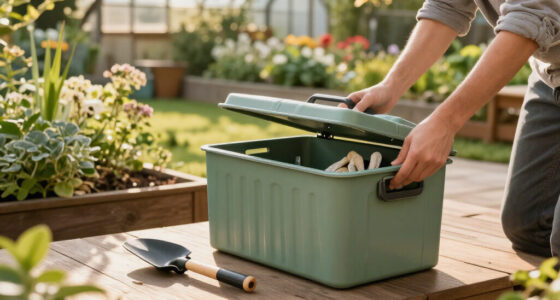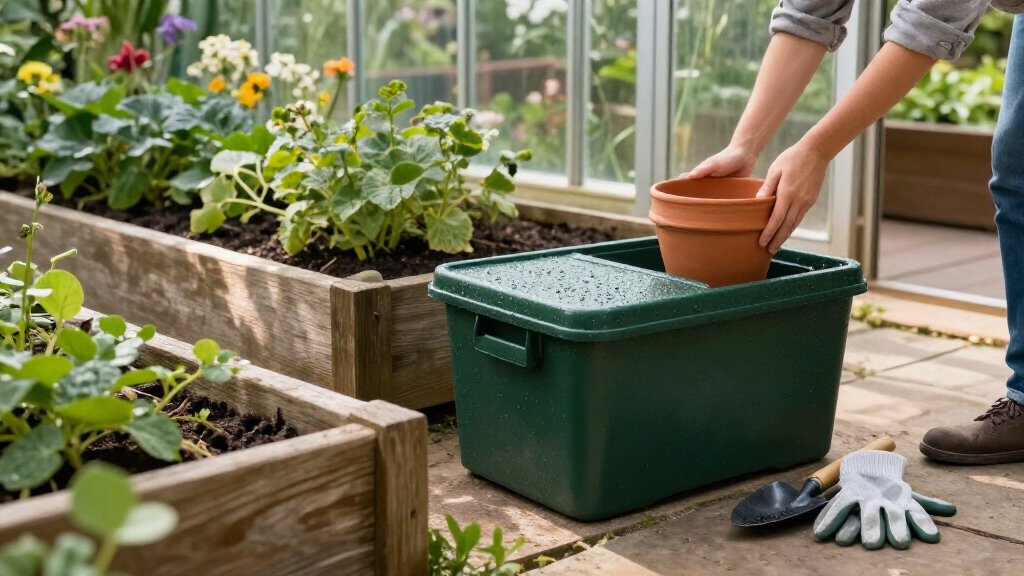
Choosing an outdoor garden storage box is a choice between convenient weather resistance and a material that feels at home among plants, timber decking and traditional garden furniture. Resin boxes usually need less routine care and suit damp or exposed spots. Wooden boxes offer a warmer, more adaptable appearance, but their finish and condition depend on upkeep and how well the box is built.

Get garden gear delivered free with Prime
- Fast, free delivery on millions of items
- Prime Video, Amazon Music and more included
- Member-only deals all year
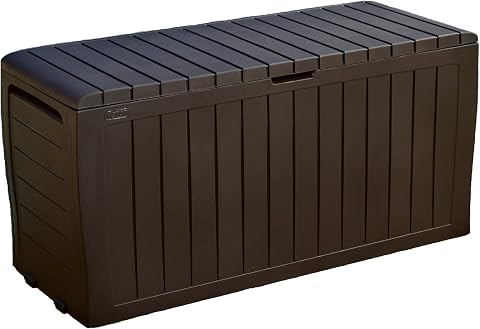
Keter Marvel 71-Gallon Outdoor Storage Box and Bench
- ✔ Capacity: 71 gallons
- ✔ Exterior dimensions: 45.9 × 17.4 × 22.2 in
- ✔ Interior dimensions: 44.6 × 15.6 × 20 in

DRATO 170-Gallon Outdoor Storage Deck Box with Wheels
- ✔ Capacity: 170 gallons
- ✔ Dimensions: 44.29 × 17.87 × 21.61 in
- ✔ Material: High-density resin

Keter City 30-Gallon Outdoor Storage Box and Patio Side Table
- ✔ Capacity: 30 gallons
- ✔ Exterior dimensions: 22.75 × 17.3 × 21.7 in
- ✔ Interior dimensions: 22.71 × 16.3 × 20.3 in
The better fit depends on what you plan to store, where the box will sit and how much maintenance you are willing to do. Resin is the practical choice for cushions, toys and everyday tools when low upkeep matters. Wood is more appealing when appearance, repairability and a garden furniture look justify extra care. Neither material alone guarantees security or waterproofing: design, lid fit, drainage and placement matter too.
At a Glance
| Criteria | Resin garden storage boxes | Wooden garden storage boxes | Winner |
|---|---|---|---|
| Weather resistance | Typically resists rain and moisture without swelling or rusting; lid seals and construction vary. | Can handle outdoor use, but untreated or poorly finished timber may absorb moisture, warp or decay. | A |
| Maintenance | Usually needs only occasional cleaning; check hinges, lid supports and UV wear. | Needs periodic cleaning and protective treatment; frequency depends on exposure and finish. | A |
| Appearance | Functional, with styles and colors that may resemble timber but can look less natural. | Natural grain suits planted gardens, patios and traditional furniture. | B |
| Strength and repairability | Lightweight and convenient, though some models flex; cracked panels can be hard to repair neatly. | Solid construction can feel sturdy; timber can often be tightened, repaired, sanded or refinished. | B |
| Security | Often has simple hasp or lock points, but lightweight panels and lids limit serious security. | Can support stronger frames and fittings, though basic wooden boxes are not secure storage by default. | Depends |
| Capacity and placement | Many sizes are easy to move; large models still need a firm, level base and lid clearance. | Available in furniture-like forms; weight and assembly can make relocation harder. | Depends |
| Cost and value | Often a lower-cost, low-upkeep option; value depends on wall thickness, lid fit and hardware. | May cost more and require ongoing treatment; worth it when appearance and repairability matter. | Depends |
Keter Marvel 71-Gallon Outdoor Storage Box and Bench
The Keter Marvel is the most balanced choice here for a patio that needs storage and a place to sit. Its 71-gallon compartment is substantially larger than the Keter City’s 30 gallons, while the stated 485-pound weight capacity makes its bench role clearer than the DRATO’s, which is described as storage rather than heavy-duty seating. Built-in handles and rollers also help when we need to reposition it around the patio.Its weather-resistant polypropylene resin and UV-resistant finish are practical for outdoor placement, and the listing says the design helps keep contents dry and ventilated. Those details make it a more flexible everyday option than the City, whose small interior is better for a few accessories. The Marvel is still a single-compartment box, however, and its 44.6-by-15.6-inch interior may not fit especially bulky items. Buyers who need to store a large cushion set may prefer the DRATO’s much greater stated volume, provided they have room for it.
Pros:
- 71-gallon capacity offers a useful middle ground between the City and DRATO.
- Bench use is supported by a stated 485-pound maximum capacity.
- Built-in rollers and handles make repositioning easier.
- Tool-free assembly and UV-resistant polypropylene resin.
Cons:
- One compartment gives no built-in separation for different items.
- The compact depth and interior dimensions can limit bulky storage.
Best for: Patio owners who want one medium-capacity box for cushions or garden accessories that can also serve as bench seating.
Not ideal for: Buyers storing a large volume of bulky gear, or anyone who needs multiple compartments or a deep interior.
Bottom line: For a versatile patio box that can also function as a bench, the Marvel offers the clearest balance of storage and secondary use in this comparison.
“For a versatile patio box that can also function as a bench, the Marvel offers the clearest balance of storage and secondary use in this comparison.”
DRATO 170-Gallon Outdoor Storage Deck Box with Wheels
When storage volume is the main constraint, the DRATO’s 170-gallon capacity puts it well ahead of both Keter options. That extra room is the reason to choose it for outdoor cushions, tools and pool accessories that would overwhelm the City and likely crowd the Marvel. Its dimensions are about the same width as the Marvel, so the higher capacity comes with a different shape and storage layout rather than a dramatically wider footprint.The lid is its other defining feature: hydraulic slow-close rods help control its movement, and the design is lockable. Wheels and a built-in handle support repositioning, while the reinforced lid has a stated maximum static load of 350 pounds. That figure is below the Marvel’s 485-pound bench capacity, and DRATO presents this model as storage rather than heavy-duty seating. We would choose it for volume and lid control, not as the lineup’s primary bench. The listing describes weather-resistant, UV-resistant high-density resin, but does not specify ventilation as the Keter models do.
Pros:
- Largest stated capacity in this comparison at 170 gallons.
- Hydraulic rods help slow and control lid movement.
- Lockable design with wheels and a built-in handle.
- Tool-free assembly and weather-resistant, UV-resistant resin.
Cons:
- Its 350-pound static load is lower than the Marvel’s stated bench capacity.
- The design is intended for storage rather than heavy-duty seating.
- Ventilation is not specified in the supplied product details.
Best for: Households that need one large outdoor box for multiple cushions, garden tools or pool accessories and value a controlled-close lid.
Not ideal for: Buyers with limited patio space, those seeking a box explicitly suited to heavy-duty seating, or shoppers who prioritize a stated ventilated interior.
Bottom line: Choose the DRATO when capacity and a controlled-close lid matter more than using the box as a substantial bench.
“Choose the DRATO when capacity and a controlled-close lid matter more than using the box as a substantial bench.”
Keter City 30-Gallon Outdoor Storage Box and Patio Side Table
The Keter City is the smallest option here, and that is precisely its advantage for a balcony, compact patio or seating area with little spare floor space. At 22.75 inches wide, it occupies much less width than the Marvel or DRATO. It can also serve as a side table or extra seat, giving the space a useful surface when the box is not being opened. For a small set of garden accessories, that two-purpose footprint can be more valuable than the DRATO’s 170-gallon capacity.Capacity is the clear compromise: 30 gallons is less than half the Marvel’s stated volume and a fraction of the DRATO’s. The City is not a substitute for a large cushion box, and its interior dimensions are unlikely to suit bulky items. Its polypropylene resin is described as weather-resistant and UV-protected, with a ventilated interior, and assembly clicks together without extra tools. The stated 220-pound maximum weight recommendation also makes its seating role more limited than the Marvel’s bench specification. Choose it for a tidy, compact setup, not for large-scale garden storage.
Pros:
- Small footprint fits balconies and tight patio layouts.
- Side-table and extra-seating functions make the space do double duty.
- Ventilated, UV-protected resin design.
- Click-together assembly needs no extra tools.
Cons:
- 30-gallon capacity is the lowest in the lineup.
- Interior dimensions limit bulky cushions and larger items.
- 220-pound maximum weight recommendation is below the Marvel’s bench capacity.
Best for: Apartment dwellers and patio owners who need a small accessory box that can double as a side table or occasional extra seat.
Not ideal for: Anyone storing several large cushions, bulky pool equipment or a substantial collection of garden tools.
Bottom line: The City is the most space-conscious choice, provided we accept a small compartment and a more limited seating load.
“The City is the most space-conscious choice, provided we accept a small compartment and a more limited seating load.”
As an Amazon Associate we earn from qualifying purchases.
Key Differences
The clearest difference is the work required to keep the box looking and functioning well. Resin usually tolerates damp conditions with less attention, which suits a box placed beside a lawn, under an open sky or near a pool. It is not automatically waterproof: water can enter through an ill-fitting lid, seams or a base sitting in standing water. Check the maker’s weather claims and provide a stable, drained location.
Wood wins on character and repair options. Its grain can blend with a garden, and a sound frame can often be tightened or refinished if the surface wears. Those advantages come with a recurring task: inspect the finish, keep water from pooling, and apply suitable protection when needed. For value, compare the full ownership picture. A basic resin box can be economical when convenience is the priority; paying more for wood makes sense when its appearance and ability to be maintained are worth the added effort.
Detailed Comparison
Weather resistance (Resin garden storage boxes wins — moderate)
Resin has the practical edge in wet or changeable conditions because it does not absorb water like untreated timber. The advantage is moderate, not absolute: poor lid seals, seams and standing water can let moisture reach stored items. Wood can perform well when properly built, sealed and positioned, but damage is more likely if protective finishes are neglected. For cushions or other items that must stay dry, use a weather-resistant box with a close-fitting lid and consider a separate waterproof bag inside.
Maintenance (Resin garden storage boxes wins — moderate)
Resin wins clearly for owners who want little ongoing care. A periodic wash and a check of hinges or lid supports will cover many routine needs. Wood calls for more attention: inspect the finish, address worn areas and protect it against moisture as recommended for that product. The gap is moderate because exposure and construction affect the workload. A sheltered wooden box may need less attention than one left in full sun and rain.
Appearance (Wooden garden storage boxes wins — major)
Wood usually looks more at home beside planting, timber furniture and traditional patios. Resin ranges from plain utility designs to convincing wood-effect finishes, but those remain a manufactured surface. The gap is major for buyers who see the box as part of the garden’s visible furniture; it is minor if the box sits behind a shed or hedge. Choose based on the actual finish and color, since product photos can make textured surfaces hard to judge.
Strength and repairability (Wooden garden storage boxes wins — moderate)
Well-built wood tends to feel more substantial and offers more options if a joint loosens or the finish wears: parts can often be tightened, replaced or refinished. Resin is lighter and can be easy to assemble, but a cracked panel may be difficult to restore cleanly. This is a moderate advantage for wood, with an important qualification: thin timber can be flimsy, and material alone does not establish load capacity. Check the stated capacity, frame construction, floor support and assembly requirements.
Security (moderate difference)
There is no universal winner. Some boxes in either material accept a padlock, but a lock point does not make the box secure against forced entry. A lightweight resin lid may be easy to pry or damage, while a sturdy wooden frame can support stronger fittings. Buyers storing valuable tools should compare the complete construction and lock design, or choose a purpose-built lockable storage unit. For ordinary cushions and toys, security may be less important than a lid that stays shut in wind.
Capacity and placement (minor difference)
Neither material wins by default. Both come in a range of sizes, so compare internal dimensions with the largest item you plan to store; listed external capacity may not reflect usable space. Resin models are often lighter to move, which helps when the box needs seasonal repositioning. Wooden models may suit a fixed spot as a furniture-like feature, but can be heavier and more involved to assemble. In either case, allow room to open the lid fully and set the box on level ground with drainage.
Cost and value (moderate difference)
Resin often offers better value when the goal is dependable everyday storage with little maintenance. Wood can justify a higher purchase price when its appearance, sturdy construction or repairability adds real value to the garden. The price gap alone does not settle the decision: compare material thickness, hinges, supports, floor design, finish and warranty. Paying more for wood is worthwhile for buyers who will maintain it and care about its look; it is poor value if the box will be neglected in an exposed, damp location.
Resin garden storage boxes: Pros and Cons
Pros:
- Usually needs little maintenance.
- Does not absorb moisture like untreated timber.
- Often light enough to reposition with less effort.
- Can provide practical storage at a modest price.
Cons:
- Some models flex or feel less substantial.
- A damaged panel may be difficult to repair neatly.
- Wood-effect finishes may not match the look of real timber.
- Lid, seams and base still need checking for water entry.
Wooden garden storage boxes: Pros and Cons
Pros:
- Natural grain can complement planting and outdoor furniture.
- A sturdy frame can feel solid and long-lasting.
- Often offers repair, refinishing and replacement options.
- Can work as a furniture-like garden feature.
Cons:
- Needs periodic finish checks and protective treatment.
- Moisture can lead to swelling, warping or decay if protection fails.
- Can be heavier and harder to reposition.
- The higher initial cost may not pay off for buyers who prefer minimal upkeep.
Who Should Choose What
Choose Resin garden storage boxes if:
- You want low-maintenance storage for cushions, children’s toys or everyday garden items.
- The box will sit in a damp or exposed spot and you prefer not to maintain a timber finish.
- You value easy cleaning and practical function more than a natural wood appearance.
Choose Wooden garden storage boxes if:
- The box will be visible on a patio and should complement wooden furniture or planting.
- You are willing to inspect and maintain the finish to preserve its condition.
- You value a solid feel and the option to repair or refinish parts over time.
Skip both if: You need robust security for expensive tools, a guaranteed dry space for sensitive equipment, or a structure rated to support heavy loads. Compare purpose-built lockable or weatherproof storage and check its specifications.
Value for Money
Resin is generally the better value when you want straightforward storage and minimal upkeep. It can cost less up front and demands less routine attention, but a very thin, poorly supported model may not last as well as its price suggests. Look closely at the lid, hinges, floor and stated capacity before buying.
Pay more for wood when its appearance is part of the reason for buying the box, or when a sturdy, repairable frame matters to you. That premium makes sense if you will keep up with protective care. If the box will be out of sight and exposed to rain, spending extra for timber is harder to justify; a well-made resin model is likely to deliver more useful value.
Final Verdict
For most buyers seeking an easy-care place for cushions, toys or routine garden gear, choose a well-built resin box. Its main advantage is less maintenance, and that practical benefit usually matters more than the appearance premium of wood. Check the lid fit, internal dimensions and floor design before purchase.
Choose wood when the box will be a visible part of the garden and you want natural grain, a substantial feel or the ability to refinish and repair it. Accept the extra care as part of the purchase. The deciding factor is simple: if low upkeep leads, buy resin; if garden character and maintainability lead, buy wood. For valuable equipment or storage that must stay reliably dry, choose neither by material label alone—look for a purpose-built product with suitable security and weather specifications.
Frequently Asked Questions
Are resin garden storage boxes waterproof?
Some are designed to resist rain, but resin alone does not make a box waterproof. Water can enter through seams, lid gaps or a poorly drained base. Check the product’s weather claims and keep the box on level ground where water will not collect.
Do wooden garden storage boxes need treatment?
Many need periodic inspection and protective treatment, especially when exposed to rain and sun. Follow the maker’s guidance for the timber and finish, and address worn areas before moisture causes damage.
Which type is better for storing outdoor cushions?
A resin box is often the easier-care choice, but the lid fit and weather rating matter more than the material label. For cushions you want to keep dry, add a waterproof storage bag and avoid leaving the box where water pools.
Can I lock a garden storage box?
Some resin and wooden models include lock points or fittings for a padlock. These help keep a lid closed but do not necessarily resist forced entry. For valuable tools, check the complete frame and lock design or choose purpose-built secure storage.