TL;DR

Get garden gear delivered free with Prime
- Fast, free delivery on millions of items
- Prime Video, Amazon Music and more included
- Member-only deals all year
Solar garden lights work well when you buy units with lithium-ion or LiFePO4 batteries (200+ lumens for path lights) and place them where they get 6+ hours of direct sun. Most failures trace to shaded panels and depleted batteries after 1–2 years, both fixable for under $10.
Your neighbor’s solar lights glow until 2 a.m. Yours die by 9:30. Same product category, same price range, same amount of sunshine — so what’s going on?
Nine times out of ten, it’s not the solar panel. It’s a tired battery, a shaded charging spot, or a $3 light being asked to do a $30 job. Solar garden lighting is genuinely good now — LED efficiency has tripled since 2010 while prices dropped — but the market is flooded with landfill fodder.
In this guide, you’ll learn which lights are worth your money, where to place them, and the five-minute fix that revives “dead” lights. Plus the safety stuff nobody mentions, like keeping battery compartments away from curious kids and pets.
Weak runtime is usually battery fade, not solar failure — swapping the NiMH cells for about $10 revives most ‘dead’ lights after 18 months.
Buy path lights rated 100+ lumens; anything under 15 lumens is decorative glow, not usable light.
Place lights where panels get 6+ hours of direct, unshaded sun — a noon shadow can halve your charge.
Wipe panels monthly with soapy water; dust alone can cut charging by up to 20%.
Keep battery compartments secured and spare cells out of reach of children and pets — the cells are a swallowing hazard.
How Solar Garden Lights Actually Work (In 60 Seconds)
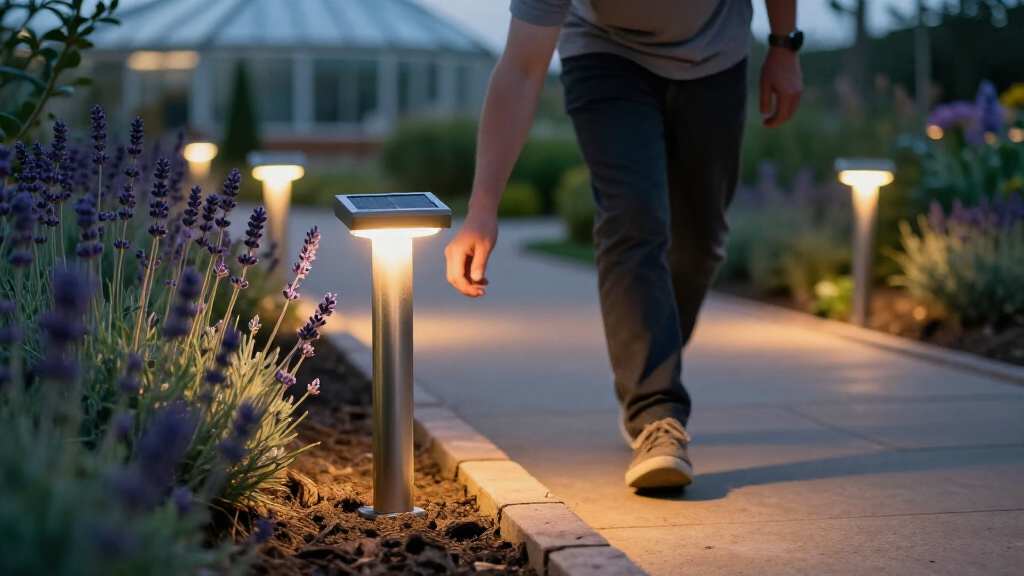
A solar garden light is a tiny off-grid power plant with four parts: a photovoltaic panel that converts sunlight to electricity, a rechargeable battery that stores it, a photosensor that switches the light on at dusk, and an LED that spends the stored energy overnight.
Why this architecture matters: it means every component is a potential bottleneck, and they fail at very different rates. The panel and LED are essentially immortal for practical purposes — a modern LED lasts 25,000+ hours and small panels degrade less than 1% a year. The battery is the weak link, and the photosensor is the second most common failure. So when a light underperforms, you’re really choosing among three suspects: not enough sunlight in, not enough storage, or the switch misfiring. Diagnosing in that order — placement, battery, sensor — solves 95% of problems without buying anything new.
Here’s the part most people miss: the panel only charges for daylight hours, and the battery only holds what the panel collects. A panel half-shaded by a hydrangea at 2 p.m. might capture just 40% of its potential charge, even if the morning was bright. That’s because shading doesn’t reduce output linearly — it’s closer to cliff behavior. Even partial shading of a small panel can disproportionately crush output, because the shaded cells block current flow through the whole panel. The practical implication: a few hours of full sun beats twelve hours of dappled light, which inverts most people’s intuition about where to stake a light.
Think of it like a rain barrel under a leaky gutter — the barrel works fine, but you can’t collect what never arrives. That’s why placement matters more than price, and why a $12 light in full sun routinely outperforms a $40 light in shade. We’ll get to that.
Why Your Solar Lights Die by 10 p.m. (It’s Almost Always the Battery)
The number one cause of dim, short-lived solar lights is battery capacity fade, not solar failure. Most budget lights ship with NiMH AA cells rated for 500–1,000 charge cycles. Used daily, that’s 18–36 months before capacity drops by a third or more.
The symptom is sneaky. In June, when days are long and warm, the battery charges fully and your light glows until dawn. By October, shorter days plus a weaker battery equals a light that flickers out three hours after sunset. The solar panel is fine. The battery is running on fumes.
Here’s why this happens chemically: every charge-discharge cycle slightly degrades the electrode structure inside a NiMH cell, and heat accelerates the damage. A garden light bakes in the sun all day, every day, so its batteries age faster than the same cells in a TV remote. This is also why cheap lights seem “designed to disappoint” — a $3 light ships with the smallest, lowest-grade cell the manufacturer can source, so capacity fade hits the usability floor within a year. Manufacturers know this; it’s a tradeoff between retail price and longevity, and the battery is where they cut corners because it’s invisible on the shelf.
The five-minute fix: unscrew the battery compartment (usually under a twist-off cap), pull the old cells, and replace them. A 4-pack of name-brand NiMH AAs costs about $10. I revived six “dead” path lights this way last spring — every single one came back to life. The tradeoff to know: name-brand replacement cells often have higher capacity than the originals, so a repaired budget light can actually outlast a new cheap one.
Before you toss a solar light in the bin, check the battery. It’s the cheapest repair in outdoor lighting and the most commonly skipped.
The 4 Types Compared: Which Solar Light Fits Your Yard
Solar garden lights come in four main styles, and picking the wrong one for the job is the second most common mistake. Here’s how they stack up:
| Type | Brightness | Best For | Typical Price | Watch Out For |
|---|---|---|---|---|
| Path/stake lights | 10–100 lumens | Edging walkways, borders | $3–$25 each | Flimsy plastic stakes snap in hard soil |
| Motion-sensor flood lights | 300–1,200 lumens | Driveways, side gates, security | $20–$80 | Need true south-facing sun exposure |
| String/fairy lights | Ambient only | Patios, pergolas, fences | $15–$40 per strand | Solar panel must reach a sunny spot — check cord length |
| Wall-mounted lanterns | 100–400 lumens | Doors, garages, entries | $25–$100 | Overhanging eaves block charging |
For context: a 60-watt incandescent bulb produces roughly 800 lumens. Path lights don’t need anywhere near that — 100 lumens per path light is plenty to see where you’re stepping without blinding guests.
But the deeper story is how each type makes tradeoffs between brightness and runtime. Brightness and battery life are locked in a tug-of-war: a light running at full brightness drains its battery 5–10x faster than a dim accent light. That’s exactly why motion-sensor floods can be so bright yet still work — they only burn that output for 20–30 seconds at a time, so a full day’s charge covers dozens of triggers. A path light asked to glow at 300 lumens all night would need a battery three times larger and a panel to match, which would triple the price. Understanding this tradeoff explains most design decisions in the category, and it tells you what not to ask for: a cheap, all-night, ultra-bright light is physically impossible with current batteries.
The type you choose also determines your maintenance burden. Flood lights and lanterns mount up high, away from mulch and leaf litter, so their panels stay cleaner. Stake lights live at ground level where grass clippings, dust, and snow bury them — meaning the cheapest type actually demands the most upkeep. Budget accordingly: not just the sticker price, but the ten minutes a month you’ll spend keeping them running.
5 Placement Rules That Double Your Runtime
Placement decides whether your light runs 4 hours or 10. Follow these in order:
- Aim for 6+ hours of direct sun. Watch your yard for a day. Any spot that gets unobstructed sun from late morning through mid-afternoon is golden.
- Keep panels clear of shade-casters. Tree canopies, fences, and even your own house shadow can slash charging by half. A shadow at noon is the most expensive shadow in your yard.
- Tilt panels toward the sun. In the northern hemisphere, a south-facing tilt catches the most light. Fixed stakes are fine; adjustable-angle mounts are better.
- Avoid reflections and competing light sources. A photosensor next to a porch light will think it’s daytime and never switch on. Space them at least 6 feet apart.
- Raise lights off the ground slightly where snow, leaf litter, or mulch could bury the panel. A few inches saves you a season of frustration.
One reader scenario I see constantly: lights staked under a beautiful maple tree. Gorgeous in photos, useless at night. The tree drinks the sunlight before the panel gets a sip.
Keep Them Glowing: The 10-Minute Monthly Routine
Solar lights ask very little, but they do ask. Dust, pollen, and grass clippings coat the panel like a dirty windshield — light gets in, but less of it.
Once a month, wipe each panel with a damp cloth and a drop of dish soap. That’s it. According to maintenance data from lighting manufacturers, a dirty panel can lose 15–20% of its charging capacity, which directly cuts your evening runtime.
- Spring: replace batteries in lights older than 18 months, check stakes for winter damage
- Summer: trim back plants that have grown over the panels
- Fall: clear leaves daily in heavy drop zones; a buried panel charges nothing
- Winter: in freezing climates, consider storing delicate lights indoors — cold accelerates battery degradation
Ten minutes a month is the difference between lights that last two seasons and lights that last eight.
Safety Notes Most Guides Skip
Solar garden lights are low-voltage and generally very safe, but a few things deserve attention — especially if you have small children or pets.
The button batteries and AA rechargeable cells inside are a choking and swallowing hazard for young kids. Screw the battery compartments shut tightly, and replace any light with a cracked housing rather than taping it closed. Curious dogs chew plastic stakes; a shattered solar light leaves small sharp fragments and exposes the cell.
If a light uses replaceable batteries, store spares in a locked drawer, not the garden shed shelf at toddler height. And when disposing of old rechargeable cells, take them to a battery recycling drop-off — most hardware stores have a bin by the entrance. Never toss them in household trash.
One more thing: solar lights don’t replace proper security lighting for stairs and entrances. They’re accent and convenience lighting. For a dark staircase, add a wired or hardwired option with reliable output.
Frequently Asked Questions
How long do solar garden lights last on a full charge?
Quality solar lights run 6–10 hours on a full charge, which covers dusk to midnight in most seasons. Cheap units with small batteries may only manage 4–5 hours. Runtime shrinks in winter when days are short and cold batteries hold less charge — expect roughly 30–50% less runtime in December than in June.
Do solar garden lights work in winter or on cloudy days?
Yes, but reduced. Panels charge on overcast days at roughly 20–40% of their sunny-day rate, so lights will come on but fade earlier. In winter, combine shorter days with weaker sun and cold-degraded batteries, and some lights last only 2–3 hours. Lithium-based lights handle cold better than NiMH ones.
Can I replace the batteries in solar garden lights?
Usually yes. Most stake lights use standard AA or AAA rechargeable cells — typically NiMH — held under a twist-off cap. Match the chemistry (NiMH for NiMH) and capacity when replacing. The swap takes about five minutes per light and costs around $2–3 per battery, versus $15+ for a new light.
How many lumens do I need for a garden path?
Aim for 100 lumens per path light for safe, comfortable visibility. Lights in the 10–30 lumen range are decorative accent glow — pretty, but you shouldn’t rely on them for seeing steps. For security or task areas like a side gate, look for 300+ lumens with a motion sensor.
Why do my solar lights stay on during the day?
The photosensor is either dirty, blocked, or faulty. Wipe the small sensor eye (usually a tiny dark dot near the panel) with a dry cloth. If a nearby wall or bright reflection tricks it, relocate the light. If neither works, the sensor has failed — time to replace that unit.
Conclusion
If you remember one thing: the battery is the heart of a solar light, and the sun is its diet. Feed it full sun, swap the battery when it fades, and even a $12 path light will outperform a neglected $40 one.
Start small. Pick your darkest walkway edge, buy three good lights, place them by the placement rules above, and watch what a difference one well-charged evening makes. Your 10 p.m. self — the one fumbling for the doorknob — will thank you.
Halloween Picks
halloween
As an affiliate, we earn on qualifying purchases.