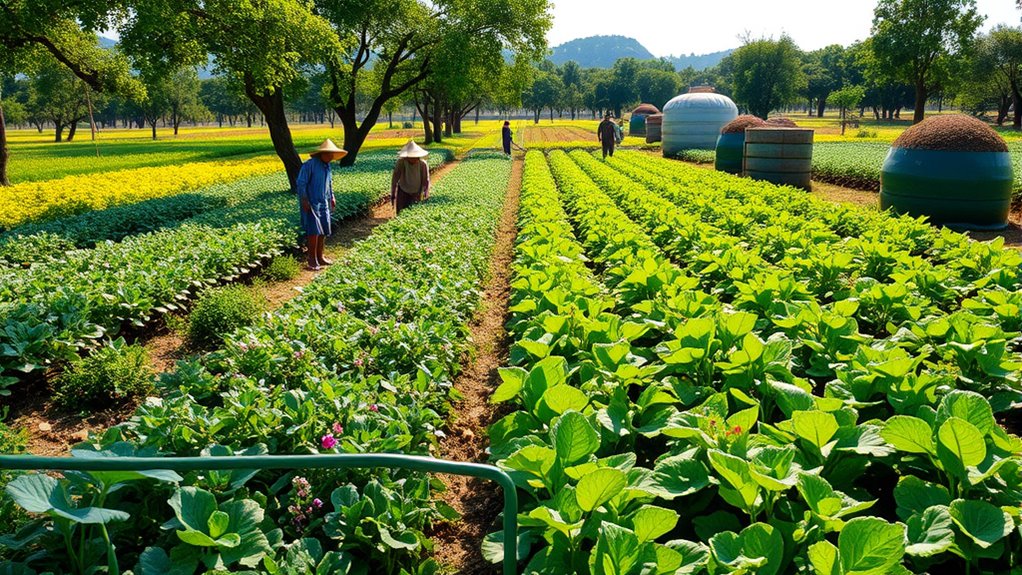

Agroecology combines ecological principles with farming practices to create sustainable, biodiverse, and resilient agricultural systems. It involves reducing chemical inputs, conserving natural resources, and supporting biodiversity on farms to improve soil health and ecosystem balance. Practices like composting, cover cropping, and promoting pollinators help boost productivity naturally. By working with nature rather than against it, agroecology benefits the environment and local communities. Keep exploring to discover how these principles can transform your approach to farming.
Key Takeaways
- Agroecology emphasizes ecological farming practices that reduce chemical inputs and enhance biodiversity for sustainable land use.
- It promotes resource-efficient methods like composting, cover cropping, and reduced tillage to improve soil and water health.
- The approach supports biodiversity conservation, including pollinators and native plants, to naturally control pests and maintain ecosystem balance.
- Community involvement and landscape-level conservation are key, encouraging knowledge sharing and cooperative efforts among farmers.
- Overall, agroecology integrates ecological principles into farming to produce healthy food while protecting environmental health.

Have you ever wondered how farming can be more sustainable and environmentally friendly? The answer lies in agroecology, a farming approach that combines ecological principles with agricultural practices. By focusing on sustainable farming, you can reduce reliance on chemical inputs, conserve natural resources, and foster resilience in your land. Central to agroecology is biodiversity conservation, which plays a critical role in creating healthy, productive ecosystems. When you promote biodiversity on your farm, you help maintain soil fertility, control pests naturally, and support pollinators that are crucial for crop production.
Implementing agroecology means designing your farming system to mimic natural ecosystems. This involves diversifying crops, integrating livestock, and applying organic methods that respect the environment. For example, planting a variety of crops instead of monocultures attracts different beneficial insects and microorganisms, which naturally keep pest populations in check. This biodiversity not only reduces the need for chemical pesticides but also enhances the resilience of your farm to climate fluctuations and disease outbreaks. By conserving native plants and maintaining habitat corridors, you provide refuge for beneficial insects, birds, and other wildlife, fostering a balanced ecosystem that sustains itself.
Diversify crops and conserve native plants to build resilient, balanced ecosystems that support beneficial insects and wildlife.
Sustainable farming within agroecology emphasizes resource efficiency. You’ll prioritize practices like composting, cover cropping, and reduced tillage, all of which improve soil health and water retention. These methods minimize erosion and nutrient runoff, safeguarding local waterways. When you adopt such practices, you’re not just protecting the environment—you’re creating a more productive, self-sustaining farm that can withstand environmental stresses over time. Supporting biodiversity hotspots on and around your farm can further enhance these benefits by preserving regions with high endemic species and ecological significance.
Another principle of agroecology is community involvement. Engaging with local farmers, sharing knowledge, and participating in cooperative efforts strengthen your capacity to adopt sustainable methods. This collective approach encourages biodiversity conservation across landscapes, leading to healthier ecosystems beyond your farm’s borders. It also supports local economies by promoting diverse, resilient food systems.
In essence, agroecology offers a pathway to transform your farm into an ecological system that works with nature rather than against it. By prioritizing sustainable farming and biodiversity conservation, you not only produce healthier food but also contribute to the health of the planet. It’s a practical, resilient approach that aligns agricultural productivity with environmental stewardship, ensuring that your land remains fertile and vibrant for generations to come.
Frequently Asked Questions
How Does Agroecology Compare Economically to Conventional Farming?
You’ll find agroecology often has higher initial costs, but a thorough cost-benefit analysis shows it can be more sustainable long-term. It improves soil health and reduces input expenses, boosting market competitiveness by appealing to eco-conscious consumers. While conventional farming may seem cheaper upfront, agroecology’s focus on resilience and ecosystem services can lead to better economic stability and profitability over time, making it a smart choice for sustainable agriculture.
Can Agroecology Be Scaled for Large Commercial Farms?
You might think agroecology can’t scale for large farms, but surprisingly, with innovative farm size adaptation strategies, it can. Scaling challenges include balancing ecological principles with commercial demands, yet many large farms are experimenting with agroecological practices. By integrating diverse crops and natural pest control, you can adapt these methods to bigger operations, proving that agroecology isn’t limited to small-scale farms—it’s a viable approach for large-scale, sustainable agriculture too.
What Are the Main Challenges in Adopting Agroecological Practices?
You face challenges in adopting agroecological practices, mainly due to limited farmer education and market access. Without proper training, you might struggle to implement sustainable methods effectively. Additionally, restricted market access can make it hard to sell your organic or diversified produce at fair prices. Overcoming these barriers requires better education programs and developing local markets, so you can successfully shift to eco-friendly farming and improve your farm’s profitability.
How Does Agroecology Impact Local Biodiversity and Ecosystems?
Like a gardener tending a delicate balance, you see agroecology boost local biodiversity and ecosystems. It enhances pollinator health by preserving natural habitats and reducing chemical use, creating a thriving environment for insects, birds, and other wildlife. This approach fosters diverse plant growth and healthy soil, strengthening ecosystems and ensuring sustainability. Your efforts help maintain ecosystem resilience, making local environments more vibrant and resilient for future generations.
Are There Government Policies Supporting Agroecological Transitions?
Yes, government initiatives actively support agroecological shifts through policy support. They create programs that promote sustainable farming practices, provide funding, and encourage research into agroecology. You can access grants, technical assistance, and training that help farmers adopt eco-friendly methods. These policies aim to shift agriculture toward sustainability, improve biodiversity, and protect ecosystems, making it easier for you and other farmers to implement agroecological principles effectively.
Conclusion
Imagine your farm as a thriving rainforest, where every plant and animal works together in harmony. Just like a balanced ecosystem, agroecology principles create resilient, productive landscapes that sustain both nature and farmers. Embracing these practices is like planting a seed today for a healthier tomorrow. By adopting agroecology, you’re nurturing a vibrant, self-sufficient system—proof that working with nature, not against it, leads to true abundance.