
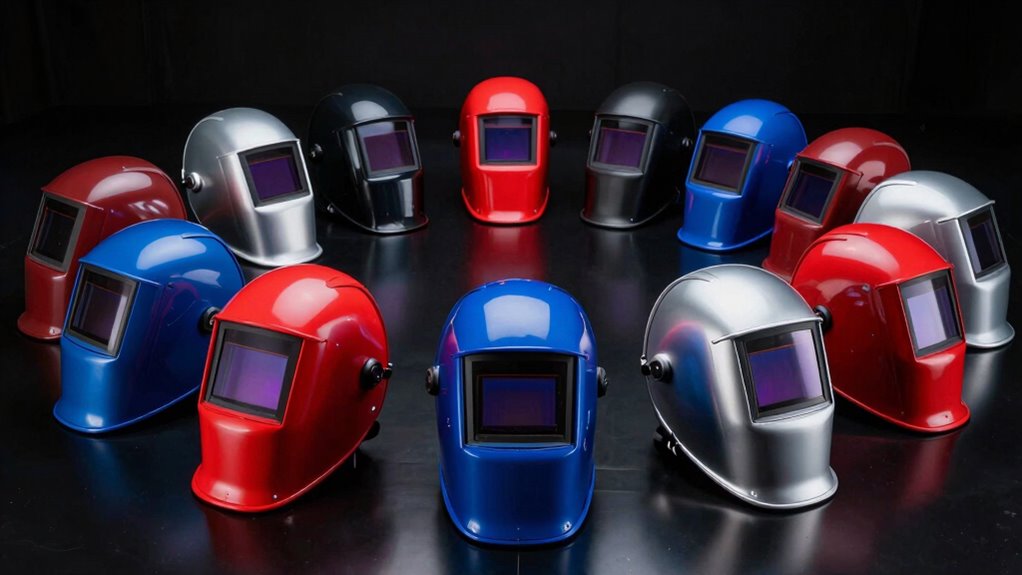

For a versatile auto-darkening welding helmet, I’d start with the ARCCAPTAIN Intelligent Auto-Darkening Welding Helmet, which pairs a 180° True Color hood with a wide view. The JASIC 1/1/1/1 True Color stands out for lens clarity, while the Miller Classic Series is a straightforward choice for welders who favor a familiar shade range and established brand. The main tradeoffs are viewing area versus a more compact hood, added lighting versus simplicity, and advanced lens features versus ease of use. Sensor count, fit, battery setup, and shade controls also affect whether a helmet suits your work. Read on for all 15 picks and the details that separate them.

Get garden gear delivered free with Prime
- Fast, free delivery on millions of items
- Prime Video, Amazon Music and more included
- Member-only deals all year
Complete the kit


Key Takeaways
- Viewing area is a major differentiator: several ARCCAPTAIN models offer a 3.94″ x 3.66″ screen, while the LIMXYZ M-001 has a more compact 3.66″ x 1.69″ viewing area.
- Lens clarity gets more specific in some listings: JASIC lists 1/1/1/1 optical clarity, while multiple other picks emphasize True Color without listing the same clarity rating.
- Lighting is a separate convenience feature: the ARCCAPTAIN and ANDELI options with lights may suit dim work areas, but a light does not replace correct shade or clear lens performance.
- Four sensors appear across several wide-view options: they may suit varied torch angles better than the LIMXYZ model’s dual-sensor arrangement, though helmet placement and work conditions still matter.
- The lineup spans distinct use cases: Miller offers a simpler Shade 8-13 approach, while models with shade ranges extending to 4/5-13 provide more adjustment for different processes and tasks.


| welding helmet auto darkening | Arc sensors | Weight | Viewing area | Shade range |
|---|---|---|---|---|
| ARCCAPTAIN Auto Darkening Weld | 4 | 2.27 pounds | — | — |
| ARCCAPTAIN Auto Darkening Weld | 4 | 2.51 pounds | — | — |
| ARCCAPTAIN Auto Darkening Weld | 4 | 1 pound | 3.94" x 3.66" | 4/5-8/9-13 |
| YESWELDER Auto Darkening Weldi | 2 | 2.2 pounds | 3.64" x 1.67" | 3/7-13 |
| Welding Helmet Auto Darkening | 4 | 1.09 kg | — | 4/5-13 |
| Auto Darkening Welding Helmet | 4 | 2.51 pounds | 3.94" x 3.23" | 4/5-9/9-13 |
| JASIC Auto Darkening Welding H | 4 | 3.05 pounds | 3.94" x 7.06" panoramic screen | Light state DIN 4; dark state DIN 5-9/9-13 |
| LIMXYZ Welding Helmet Auto-Dar | 2 | 1.06 pounds | 3.66" x 1.69" | 4-13 |
| Welding Helmet with Large View | 4 | 2.36 pounds | — | — |
| ARCCAPTAIN Auto Darkening Weld | 4 | 1 pound | 3.86" x 1.69" | 4/9-13 |
| YESWELDER Auto Darkening Weldi | 4 | Approximately 1.32 lb (600 g), per description | 3.93 x 3.66 inches | — |
| ANDELI Auto Darkening Welding | 6 | — | 3.94 x 3.74 inches with side view | DIN 4 to DIN 16 |
| ARCCAPTAIN Intelligent Auto-Da | 7 | — | 7.2 x 3.2 inches | — |
| Miller Classic Series Welding | 2 | — | 6 square inches | — |
| YESWELDER LYG-L600A Auto-Darke | 2 | — | 3.64 x 1.67 inches | 3/7-13 |
More Details on Our Top Picks
ARCCAPTAIN Auto Darkening Welding Helmet, 3.94″ x 3.66″ Large Viewing Screen
I’d put this ARCCAPTAIN first for buyers who want a roomy view without giving up a broad shade range. Its 3.94″ x 3.66″ screen is larger than the YESWELDER LYG-L600A’s 3.64″ x 1.67″ viewing area, which can make it easier to track the workpiece and surrounding area without frequent head movement. Four arc sensors and DIN 5-9/9-13 dark shades suit a wider range of welding tasks than a compact, narrow-window hood. The solar cell works alongside a CR2450 battery, though that battery may need replacement over time. At 2.27 pounds, it is lighter than the other large-screen ARCCAPTAIN option here, but it is not as light as the helmet with the built-in LED, listed at one pound. I’d choose this for the view and balanced feature set, not for the lightest possible fit.
Pros:- Large 3.94″ x 3.66″ viewing screen gives a broad view of the weld area.
- Four arc sensors support automatic darkening across the lens.
- DIN 5-9/9-13 dark shade range covers multiple welding conditions.
- Solar cell and CR2450 battery provide two power sources.
Cons:- The CR2450 battery may need replacement during the helmet’s service life.
- At 2.27 pounds, it is not the lightest option in this group.
- The provided product details do not specify response time or optical clarity rating.
Best for: Welders who want a large viewing window and broad shade selection for varied shop tasks.
Not ideal for: Welders prioritizing the lowest listed weight or a built-in work light; the LED-equipped ARCCAPTAIN is listed at one pound.
- Viewing screen:3.94″ x 3.66″
- Auto-darkening shades:DIN 4 light; DIN 5-9/9-13 dark
- Arc sensors:4
- Weight:2.27 pounds
- Material:Polypropylene and polyamide
- Power source:Solar cell and CR2450 lithium battery
- Compliance:ANSI Z87.1, EN379, CE, CSA Z94.3
Our verdict“Choose this ARCCAPTAIN if a large viewing area and broad shade range matter more than minimum weight or a built-in light.”
ARCCAPTAIN Auto Darkening Welding Helmet, 3.94″×3.66″
This ARCCAPTAIN earns its place for buyers who want a stated response-time figure alongside a large view. The lens is rated to darken in 1/25,000 second, and four sensors pair with adjustable sensitivity and brightness for different working conditions. Like the B0DTKC2WTZ ARCCAPTAIN, it has a 3.94″ x 3.66″ screen and DIN 5-9/9-13 dark shades; its useful distinction is the specified response time, while the other model lists solar-cell power and a slightly lower weight. This version weighs 2.51 pounds and uses two included lithium metal batteries, so it is the heavier choice between the two large-screen ARCCAPTAIN hoods. I’d favor it when response details and adjustable controls matter more than weight. Its listed operating range also gives buyers a reference for temperature limits.
Pros:- Specified 1/25,000-second auto-darkening response time.
- Large 3.94″ x 3.66″ viewing area.
- Four arc sensors and adjustable sensitivity and brightness.
- Two lithium metal batteries are included.
Cons:- At 2.51 pounds, it is heavier than the other large-screen ARCCAPTAIN in this batch.
- Battery replacement may be needed over time.
- A single listed size may not suit every head shape or fit preference.
Best for: Welders who want a large viewing area, adjustable sensitivity, and a stated auto-darkening response time.
Not ideal for: Buyers seeking the lightest large-screen hood or a solar-cell power system; the other large-screen ARCCAPTAIN weighs less and lists solar power.
- Viewing screen:3.94″ x 3.66″
- Auto-darkening response time:1/25,000 second
- Arc sensors:4
- Protection levels:DIN 4 light; DIN 5-9/9-13 dark
- Weight:2.51 pounds
- Power:2 included lithium metal batteries
- Operating temperature:-5°C to 55°C
- Storage temperature:-20°C to 70°C
Our verdict“Pick this model if a documented fast response and adjustable lens controls outweigh the extra weight.”
ARCCAPTAIN Auto Darkening Welding Helmet with Light, 3.94″ x 3.66″ Large View
The built-in LED and listed one-pound weight make this ARCCAPTAIN the standout for welders who value visibility and reduced head load. Its 3.94″ x 3.66″ viewing area matches the two other ARCCAPTAIN helmets here, while the 1/25,000-second response and four sensors provide familiar auto-darkening essentials. Compared with the B0DTKC2WTZ, this one is far lighter and adds an LED for dim work areas; the tradeoff is that the light requires manual attachment, so it is not simply ready to use as an integrated feature. Its shade range is listed as 4/5-8/9-13, and it includes a CR2450 lithium battery with solar power. The controls may take more attention to set, making this a stronger match for users comfortable adjusting their helmet than for someone seeking the simplest setup.
Pros:- Listed weight of one pound can reduce load during longer sessions.
- Large 3.94″ x 3.66″ viewing area with true-color technology.
- Four sensors and a stated 1/25,000-second response time.
- Solar power plus an included CR2450 battery.
Cons:- The LED light requires manual attachment.
- The controls may be complex for buyers who want a simple setup.
- The CR2450 battery may need periodic replacement.
Best for: Welders who work in dim spaces and want a large-view auto-darkening hood with a low listed weight.
Not ideal for: Buyers who want a ready-to-use integrated light or straightforward controls; the light requires manual attachment and the controls may feel complex.
- Viewing area:3.94″ x 3.66″
- Auto-darkening response time:1/25,000 second
- Arc sensors:4
- Shade range:4/5-8/9-13
- Weight:1 pound
- Power source:Solar with lithium battery
- Battery:1 x CR2450 lithium battery, included
- Certification:ANSI Z89.1, CSA Z94.3, DIN EN 379
Our verdict“Choose this ARCCAPTAIN if low listed weight and extra work-area lighting are more useful to you than the simpler setup of the other large-screen models.”
YESWELDER Auto Darkening Welding Helmet LYG-L600A True Color
The YESWELDER LYG-L600A is the clarity-focused choice for buyers who can work with a compact window. Its 1/1/1/1 optical clarity rating and true-color view emphasize a clean, consistent image, while the stated 1/30,000-second response is faster on paper than the 1/25,000-second figure listed for the ARCCAPTAIN models in this batch. The tradeoff is the 3.64″ x 1.67″ viewing area: it is much narrower than those ARCCAPTAIN screens, so it offers less peripheral view of the work area. Two sensors also give it fewer detection points than their four-sensor designs. It supports TIG, MIG, MMA, and grinding, but at 2.2 pounds it is not a lightweight alternative. I’d select it for its clarity rating and stated process range, not for broad visibility or minimum weight.
Pros:- Specified 1/1/1/1 optical clarity rating.
- True-color viewing supports a more natural view of the work area.
- Stated 1/30,000-second auto-darkening response.
- Supports TIG, MIG, MMA, and grinding.
Cons:- The 3.64″ x 1.67″ viewing area is much smaller than the ARCCAPTAIN large screens.
- Two arc sensors, fewer than the four sensors on the ARCCAPTAIN options.
- At 2.2 pounds, it is not a light choice for extended wear.
Best for: Welders who prioritize a specified optical clarity rating and use multiple processes, including TIG, MIG, or MMA.
Not ideal for: Welders who want a broad peripheral view or four-sensor coverage; its window is narrow and it has two sensors.
- Viewing area:3.64″ x 1.67″
- Optical clarity:1/1/1/1
- Arc sensors:2
- Response time:1/30,000 second
- Shade range:3/7-13
- Material:ABS and PP
- Weight:2.2 pounds
- Standards:ANSI Z87.1, CSA Z94.3
Our verdict“Choose the LYG-L600A for its specified optical clarity and process versatility if a narrow viewing window is acceptable.”
Welding Helmet Auto Darkening True Color Large Viewing with Wide Shade 4/5-13, Solar/Rechargable Battery Powered, 4 Arc Sensors, Optical Clarity
This H-21 stands out for a shade range listed through shade 13, making it the most direct fit here for buyers who want that upper range in one helmet. It combines four arc sensors, solar and rechargeable-battery power, and an adjustable fit with a large viewing area, although the supplied data does not give the screen dimensions or a numerical response time. That makes its auto-darkening performance harder to compare on paper with the ARCCAPTAIN models, which list a 1/25,000-second response and defined screen dimensions. The H-21 also weighs 1.09 kg, noticeably more than the one-pound LED-equipped ARCCAPTAIN as listed, which may matter during long shifts. I’d consider it for its broad shade specification and rechargeable power setup, but not if published clarity or response details are a deciding factor.
Pros:- Listed shade range extends through shade 13.
- Four arc sensors support auto-darkening.
- Solar and rechargeable-battery power are specified.
- Adjustable size and buckle closure allow fit adjustment.
Cons:- The provided specifications do not state the viewing-area dimensions.
- No numerical auto-darkening response time or optical clarity rating is provided.
- At 1.09 kg, it is heavier than the one-pound ARCCAPTAIN with a light.
Best for: Welders seeking a four-sensor auto-darkening helmet with a listed shade range reaching 13 and solar/rechargeable power.
Not ideal for: Buyers who need a stated viewing-window size, numerical optical clarity rating, or response-time figure to compare helmets.
- Model:H-21
- Material:Plastic
- Size:Adjustable
- Weight:1.09 kg
- Arc sensors:4
- Shade range:4/5-13
- Power source:Solar/rechargeable battery
- Standards:ANSI, CE
Our verdict“Pick the H-21 if its shade range and solar/rechargeable power matter more than having detailed response-time and viewing-area specifications.”
Auto Darkening Welding Helmet with True Color View, Large 3.94″x3.23″ Viewing Area, 4 Arc Sensors, Blue Light & UV/IR Blocking, Wide Shade Range 4/5-9/9-13
This helmet makes sense for welders who want a broad, natural view of the weld pool without moving up to the JASIC helmet’s much wider panoramic layout. Its 3.94″ x 3.23″ viewing area and 1/1/1/1 optical clarity are aimed at reducing the green cast that can make it harder to judge the work. Four sensors support auto-darkening, while the 4/5-9/9-13 shade range accommodates a range of processes. Blue-light, UV, and IR protection add to its eye-protection features, and external shade control can make adjustments more convenient. The tradeoff is a 2.51-pound weight, considerably more than the 1-pound ARCCAPTAIN. Its plastic construction and replaceable-battery needs also make it less compelling for buyers prioritizing a lighter helmet or heavy-duty feel.
Pros:- Large 3.94″ x 3.23″ viewing area with 1/1/1/1 optical clarity
- Four arc sensors support responsive auto-darkening
- Wide shade range covers multiple welding applications
- Includes two inner and two outer replacement lenses
Cons:- At 2.51 pounds, it is substantially heavier than the 1-pound ARCCAPTAIN
- Battery replacement may be needed over time
- Plastic construction may feel less suited to heavy-duty use
Best for: Welders who want a large, true-color view, four-sensor switching, and external shade adjustment for varied shop tasks.
Not ideal for: Welders who wear a helmet for long sessions and prioritize low weight, or those who need a more rugged-feeling option for demanding daily use.
- Viewing area:3.94″ x 3.23″
- Arc sensors:4
- Shade range:4/5-9/9-13
- Optical clarity:1/1/1/1
- Power:Battery powered with solar assist
- Included replacement lenses:2 inner and 2 outer
- Material:Plastic
- Weight:2.51 pounds
Our verdict“Choose this helmet for a roomy, natural-color view and broad shade coverage, but pick the lighter ARCCAPTAIN if long-wear comfort matters more.”
JASIC Auto Darkening Welding Helmet, 1/1/1/1 True Color Welding Hood
The JASIC’s defining advantage is its 3.94″ x 7.06″ panoramic screen, which adds fixed DIN 5 side windows to the auto-darkening main lens. That extra peripheral view can help when tracking nearby work or repositioning, while the main window retains 1/1/1/1 clarity and four-sensor switching. Compared with the first product in this group, which offers a large single viewing area, JASIC gives up some simplicity for a much wider field of view. Its glove-friendly adjustment knobs and ergonomic interior also suit longer sessions. The tradeoff is weight: at 3.05 pounds, it is the heaviest option here and notably heavier than the ARCCAPTAIN. Its side windows are fixed rather than auto-darkening, so buyers should not mistake the panoramic layout for one continuous changing-shade lens.
Pros:- Wide 3.94″ x 7.06″ layout adds peripheral visibility
- Main lens has 1/1/1/1 optical clarity and four arc sensors
- Adjustment knobs are designed to work with thick gloves
- Solar panels supplement two CR2450 lithium batteries
Cons:- At 3.05 pounds, it is the heaviest helmet in this group
- Side windows are fixed at DIN 5 rather than auto-darkening
- The panoramic format may be unnecessary for welders who mainly need a standard central view
Best for: Welders who frequently reposition around large workpieces and value peripheral visibility alongside a clear main auto-darkening lens.
Not ideal for: Welders who need a lightweight hood for extended overhead work or prefer a single auto-darkening viewing window without fixed side panels.
- Viewing area:3.94″ x 7.06″ panoramic screen
- Arc sensors:4
- Auto-darkening response:1/25000 second
- Shade range:Light state DIN 4; dark state DIN 5-9/9-13
- Optical clarity:1/1/1/1
- Power:Dual front solar panels and two CR2450 lithium batteries
- Weight:3.05 pounds
- Material:Green PP plastic
Our verdict“Pick the JASIC if seeing around the weld zone is a priority, but choose the ARCCAPTAIN for a much lighter helmet.”
LIMXYZ Welding Helmet Auto-Darkening Hood with Solar Power, 3.66″ x 1.69″ Viewing Area, Dual Arc Sensors, Shade Range 4‑13 (Model M-001)
The LIMXYZ is a straightforward choice for welders who want a wide shade range and solar-assisted power without paying for a more elaborate view system. Its shade range of 4-13 covers several processes, and the stated 1/10,000-second response gives buyers a clear switching-speed figure. Two sensors and adjustable sensitivity provide basic control, though the four-sensor helmets in this group—including the first product and ARCCAPTAIN—offer more sensor coverage. The viewing area measures 3.66″ x 1.69″, so it is better suited to focused work than the JASIC’s panoramic screen or the wider single-window options. At 1.06 pounds, it is close to the lightest helmet here, but the listed weight may still feel noticeable during long sessions. Solar assist helps supplement the included batteries, not eliminate eventual replacement.
Pros:- Shade range of 4-13 supports a variety of welding processes
- Specified 1/10,000-second auto-darkening response
- Solar-assisted power with two CR2032 batteries included
- At 1.06 pounds, it is lighter than most helmets in this group
Cons:- Dual sensors provide less sensor coverage than the four-sensor alternatives
- The 3.66″ x 1.69″ viewing area is narrower than the larger-screen picks
- Batteries may need replacement over time
Best for: Occasional or multi-process welders who want shade flexibility, solar-assisted power, and a lighter hood without needing a panoramic view.
Not ideal for: Welders who depend on broad peripheral visibility, want four-sensor coverage, or spend long shifts in a helmet and need the lowest possible weight.
- Viewing area:3.66″ x 1.69″
- Arc sensors:2
- Auto-darkening response:1/10,000 second
- Shade range:4-13
- Power:Battery powered with solar assist
- Batteries:2 CR2032 included
- Weight:1.06 pounds
- Model:M-001
Our verdict“Choose the LIMXYZ for a relatively light, adaptable helmet for varied processes, but favor a four-sensor model for broader arc coverage.”
Welding Helmet with Large Viewing Screen and Auto Darkening
This helmet pairs a 4.05″ x 3.54″ true-color screen with four arc sensors and adjustable sensitivity and delay, giving welders useful control over how the filter reacts across different tasks. Its viewing area is larger than the first product’s 3.94″ x 3.23″ window, while its weight of 2.36 pounds is lower than that model’s but still well above the 1-pound ARCCAPTAIN. The stated 1/10,000-second switching time and solar power make it a practical option for users who want a large central view without the JASIC’s heavier panoramic construction. It also lists ANSI Z87.1 and CSA Z94.3 compliance. The downside is limited detail about battery life and the exact shade steps: the listing gives a broad shade notation but less clarity than the ARCCAPTAIN’s specified shade range and power details.
Pros:- Large 4.05″ x 3.54″ viewing screen with true-color technology
- Four arc sensors with adjustable sensitivity and delay
- Solar-powered design
- Lists ANSI Z87.1 and CSA Z94.3 standards
Cons:- At 2.36 pounds, it is much heavier than the 1-pound ARCCAPTAIN
- Battery-life details are not provided
- The shade notation is less specific than the ARCCAPTAIN’s listed range
Best for: Regular shop welders who want a large true-color window and adjustable sensitivity and delay for changing work conditions.
Not ideal for: Welders who need a very light helmet for long shifts or want detailed battery and shade specifications before choosing.
- Viewing screen:4.05″ x 3.54″
- Arc sensors:4
- Auto-darkening response:1/10,000 second
- Shade notation:4~5/8-9/13
- Power:Solar power
- Weight:2.36 pounds
- Standards:ANSI Z87.1, CSA Z94.3
- Adjustments:Sensitivity and delay
Our verdict“Choose this model for a large, adjustable viewing setup, but select the ARCCAPTAIN if reduced helmet weight and fuller power specifications matter more.”
ARCCAPTAIN Auto Darkening Welding Helmet with 1/25000s Response and True Color Technology
At just 1 pound, this ARCCAPTAIN is the clear choice in this group for welders who want to limit neck strain during longer sessions. It combines that low weight with 1/1/1/1 optical clarity, four sensors, and a stated 1/25000-second response, matching the JASIC’s response figure while avoiding its 3.05-pound weight. The 3.86″ x 1.69″ viewing area is more compact than the large screens on the first and fourth products, so it favors a lighter, focused setup over a broad work-zone view. Solar cells and replaceable CR2450 batteries provide backup power, and the listing names several safety standards. Its 12-in-1 smart filter and adjustment controls may add complexity for first-time users, while the narrow viewing window is a real compromise for welders who value peripheral visibility.
Pros:- Lightweight 1-pound construction supports longer wear
- Fast stated 1/25000-second response with four sensors
- 1/1/1/1 optical clarity and a 12-in-1 smart filter
- Solar power with replaceable CR2450 batteries and listed safety standards
Cons:- The 3.86″ x 1.69″ viewing area is narrower than the larger-screen options
- Adjustment controls may take time for beginners to learn
- Replaceable batteries may need changing over time
Best for: Welders who wear a helmet for extended periods and prioritize low weight, fast switching, and listed safety-standard compliance.
Not ideal for: Welders who want a broad viewing area or simple controls, or who would rather avoid eventual battery replacement.
- Viewing area:3.86″ x 1.69″
- Arc sensors:4
- Auto-darkening response:1/25000 second
- Shade range:4/9-13
- Optical clarity:1/1/1/1
- Power:Solar and replaceable CR2450 lithium batteries
- Weight:1 pound
- Standards:ANSI Z87.1, EN379, CE, CSA Z94.3
- Filter:12-in-1 smart filter with UV/IR protection
Our verdict“Pick the ARCCAPTAIN if low weight and fast switching outrank screen size, but choose the JASIC or first product for a broader view.”
YESWELDER Auto Darkening Welding Helmet, Large View, LYG-M800H
The LYG-M800H makes a strong all-around choice for welders who want a generous view and one helmet for several common processes. Its 3.93 x 3.66-inch viewing area and 1/1/1/1 true-color rating help keep the puddle and joint edges visible, while four sensors and a stated 1/30,000-second response support dependable auto-darkening during routine work. Shade settings cover welding, cutting, and grinding, giving it broader process flexibility than the Miller Classic Series, whose listed shade range is more focused. The tradeoff is that its listed shade control and feature set are less elaborate than the panoramic ARCCAPTAIN 180°. At about 1.32 pounds by the product description, it is a practical fit for home and general shop sessions, though the listed technical details do not specify certification standards.
Pros:- Large 3.93 x 3.66-inch viewing area with 1/1/1/1 true-color clarity
- Four arc sensors and a stated 1/30,000-second switching response
- Shade settings span DIN 3/5-9 and 9-13 for multiple processes
- Lightweight design with adjustable headgear and reinforced hinge
Cons:- Technical details provided do not list ANSI or other certification standards
- Uses an accessible CR2450 battery rather than the rechargeable setup listed for the ARCCAPTAIN 180°
- Does not include the integrated work light or memory modes found on more feature-heavy options
Best for: Home-garage welders and small-shop fabricators who want a large, clear view and shade settings for welding, cutting, and grinding.
Not ideal for: Buyers who need listed certification details or advanced panoramic viewing and memory features; the ARCCAPTAIN 180° offers a wider, more feature-rich setup.
- Viewing area:3.93 x 3.66 inches
- Optical clarity:1/1/1/1 true color
- Arc sensors:4
- Switching speed:1/30,000 second
- Shade settings:DIN 3/5-9 and 9-13
- Weight:Approximately 1.32 lb (600 g), per description
- Power:CR2450 lithium battery
- Applications:WELD, CUT, GRIND; TIG, MIG, Stick, and cutting listed
Our verdict“Choose the LYG-M800H for a clear, broad view and versatile everyday shade control without the added complexity of a panoramic premium-style helmet.”
ANDELI Auto Darkening Welding Helmet with Light, Upgraded Solar Powered
The ANDELI’s clearest distinction is its motion-sensing LED lighting: four lights provide up to 400 lumens, helping illuminate the workpiece when shop lighting is poor. Its 1/1/1/1 optics, side-view design, and six arc sensors also give it a strong visibility setup for welders who work in changing positions. Compared with the simpler YESWELDER LYG-M800H, ANDELI adds rechargeable power and an integrated light, but its listed shade range starts at DIN 4 rather than DIN 3. The 2100mAh battery and Type-C charging reduce reliance on disposable cells, though charging adds another maintenance step. The product description flags bulk as a possible drawback, so I would favor it for stationary repair or fabrication tasks over jobs where a lighter helmet matters most.
Pros:- Four motion-sensing LED lights provide up to 400 lumens
- Six arc sensors and 1/1/1/1 optical clarity
- Panoramic viewing area includes side view
- Rechargeable 2100mAh battery with Type-C charging and solar power backup
Cons:- Product description notes that the helmet may feel bulky during extended wear
- Shade range begins at DIN 4, unlike options listing a DIN 3 light state
- Built-in lights and rechargeable power add features and upkeep that basic helmets avoid
Best for: Repair welders and fabricators working in dim bays who want a built-in motion-sensing light, side visibility, and rechargeable power.
Not ideal for: Welders who prioritize a lighter, simpler helmet or need a listed DIN 3 light-state option; the YESWELDER LYG-M800H lists a lighter design and DIN 3 settings.
- Viewing area:3.94 x 3.74 inches with side view
- Optical clarity:1/1/1/1
- Arc sensors:6
- Shade range:DIN 4 to DIN 16
- Lighting:4 motion-sensing LED lights, up to 400 lumens
- Battery:2100mAh rechargeable
- Charging:Type-C fast charging
- Power source:Solar powered with battery backup
Our verdict“Pick the ANDELI if you often weld in dim spaces and value integrated lighting more than a lighter, simpler helmet.”
ARCCAPTAIN Intelligent Auto-Darkening Welding Helmet, 180° True Color Hood
The ARCCAPTAIN 180° is the pick for welders who want a panoramic view and more control over how the helmet behaves from job to job. Its 7.2 x 3.2-inch viewing area combines a main lens with side lenses, while seven sensors and a stated 1/30,000-second response support auto-darkening across a broad field. Memory modes and gradient control let users save or adjust settings, a level of customization absent from the more straightforward YESWELDER LYG-M800H. A built-in LED can help in low light, and solar assist backs up the rechargeable battery. The tradeoff is complexity: the controls may take time to learn, and the stated operating time falls from up to 1,200 hours without the LED to 500 hours with it. Its many features suit regular, varied work better than occasional basic welding.
Pros:- Wide 7.2 x 3.2-inch viewing area with main and side lenses
- Seven sensors and a stated 1/30,000-second response
- Memory modes and gradient control allow customized settings
- Rechargeable battery with solar assist and integrated LED work light
Cons:- Multiple controls and modes may take time to learn
- Listed operating time is lower when the LED is used
- Advanced features may be unnecessary for basic, occasional welding
Best for: Frequent welders switching between jobs who want panoramic peripheral visibility, saved settings, and an integrated work light.
Not ideal for: Occasional welders seeking straightforward controls or buyers who do not need side lenses and memory settings; the YESWELDER LYG-M800H offers a simpler multi-process setup.
- Viewing area:7.2 x 3.2 inches
- Main lens:4.6 x 3.2 inches
- Side lenses:1.3 x 2.5 inches
- Optical clarity:1/1/1/1
- Arc sensors:7
- Response time:1/30,000 second
- Battery:Rechargeable 500mAh with solar assist
- Listed operation time:Up to 1,200 hours without LED; 500 hours with LED
- Additional features:Built-in LED work light, memory modes, gradient control
Our verdict“Choose the ARCCAPTAIN 180° if panoramic awareness and customizable settings matter more to you than a simple, lightweight setup.”
Miller Classic Series Welding Helmet, ClearLight™, Shade 8-13, Black
The Miller Classic Series suits welders who prefer a known, focused set of controls over a wide shade range and extra electronics. Its ClearLight lens is designed to provide a natural view, with adjustable shade, delay, and sensitivity for tailoring the auto-darkening response to TIG or MIG work. The listed 6-square-inch viewing area is smaller than the panoramic ARCCAPTAIN 180°, and two arc sensors are fewer than the four on the YESWELDER LYG-M800H; those differences make Miller the less expansive choice for peripheral visibility and sensor coverage. It does list ANSI, CSA, and CE standards, along with a three-year warranty. Shade options are narrower, though, so buyers who need a broad range across multiple processes may prefer YESWELDER’s wider settings.
Pros:- ClearLight lens with adjustable shade, delay, and sensitivity
- Listed ANSI Z87.1+, CSA, and CE standards
- Adjustable ratchet headgear and nylon shell
- Three-year warranty is specified
Cons:- Two arc sensors, fewer than the four on the YESWELDER LYG-M800H
- 6-square-inch viewing area is less expansive than panoramic options
- Welding shade range is 8-13, with more limited listed process coverage
Best for: TIG and MIG welders who want adjustable digital controls, listed safety standards, and a focused helmet from an established welding brand.
Not ideal for: Welders who need broad multi-process shade flexibility, a panoramic field of view, or more than two listed arc sensors.
- Viewing area:6 square inches
- Lens technology:ClearLight
- Welding shade range:8-13
- Cut shades:5-8
- Grind shade:3
- Switching speed:1/23,000 second
- Arc sensors:2
- Standards:ANSI Z87.1+, CSA, CE
- Warranty:3 years
Our verdict“Choose the Miller Classic if you mainly weld TIG or MIG and value adjustable controls and listed standards over panoramic views and broad shade coverage.”
YESWELDER LYG-L600A Auto-Darkening Welding Helmet
The YESWELDER LYG-L600A keeps the essentials for varied home-shop work: 1/1/1/1 true-color optics, a stated 1/30,000-second response, and shade settings for TIG, MIG, arc welding, and grinding. Its 3.64 x 1.67-inch viewing area is notably narrower than the LYG-M800H, so it gives up a broad view of the weld zone in exchange for a more compact lens format. Two sensors also make it a less sensor-rich option than the M800H’s four, a difference buyers may weigh for work where arc detection conditions vary. On the plus side, it lists ANSI and CSA standards, a solar panel, and a CR2450 battery. This makes sense for buyers who want a capable, standards-listed basic hood, but not for those whose main priority is maximum viewing width.
Pros:- 1/1/1/1 optical clarity with true-color technology
- Stated 1/30,000-second response time
- Shade settings support TIG, MIG, MMA/ARC, and grinding
- ANSI Z87.1 and CSA Z94.3 standards are listed
Cons:- 3.64 x 1.67-inch viewing area is much narrower than the LYG-M800H
- Two arc sensors, compared with four on the LYG-M800H
- Uses a CR2450 battery alongside solar power
Best for: Home and hobby welders who need one compact helmet for TIG, MIG, arc welding, and grinding and want listed ANSI and CSA standards.
Not ideal for: Fabricators who prioritize a wide view or more sensor coverage; the YESWELDER LYG-M800H has a larger listed viewing area and four sensors.
- Viewing area:3.64 x 1.67 inches
- Optical clarity:1/1/1/1
- Response time:1/30,000 second
- Shade range:3/7-13
- Arc sensors:2
- Power source:Solar panel and CR2450 battery
- Material:ABS and PP
- Certifications:ANSI Z87.1, CSA Z94.3
Our verdict“Pick the LYG-L600A for a compact, multi-process helmet with listed standards, but choose the LYG-M800H if a wider view matters more.”

How We Picked
I compared these helmets by the factors that change the welding experience most: lens clarity, viewing area, shade range, sensor arrangement, response information, power setup, lighting, and fit-related practicality. A large window can make it easier to monitor the joint and surrounding work, while a clearly stated optical-clarity rating gives a more specific point of comparison than a general True Color claim. I also noted which listings identify four sensors, a light, solar power, or a stated response time rather than treating every feature as equally useful for every buyer.
The ranking favors options whose stated features support a broad range of work without making the buying decision needlessly complicated. The ARCCAPTAIN 180° True Color model leads on its stated wide-view approach; JASIC earns distinction for its listed 1/1/1/1 clarity; and the Miller is a simpler alternative with a defined Shade 8-13 range. Other ARCCAPTAIN and YESWELDER models remain useful alternatives, but overlapping names and similar listed features make it important to confirm the exact model and specifications before ordering. I do not treat unlisted certifications, fit details, or performance claims as proven.
Factors to Consider When Choosing Welding Helmet Auto Darkening
Choosing an auto-darkening hood is not just a matter of picking the biggest lens or the longest feature list. I’d match the helmet to your welding processes, working position, surroundings, and tolerance for adjustments. These factors help separate genuinely useful features from specifications that may not affect your daily work.
Match the Shade Range to Your Processes
Start with the welding processes and amperage ranges you actually use, then check the helmet’s shade settings against the recommendations for that work. A wider listed range, such as 4/5-13, offers more adjustment options than a fixed or narrower range, but it does not automatically make a helmet better for every job. Some buyers may value a simpler range like the Miller’s stated Shade 8-13 if it aligns with their work and they prefer fewer settings. Do not assume a helmet’s lowest shade is suitable for every grinding or cutting task. Check the manufacturer’s instructions and applicable safety guidance for each process. If you switch processes often, prioritize clear, accessible controls and a range that covers those tasks.
Treat Viewing Area and Optical Clarity as Different Questions
A larger viewing window shows more of the work area, which can help when positioning a torch or tracking a longer joint. It may also add bulk, so consider whether the shell fits your workspace and clears nearby surfaces when you move your head. Optical clarity describes how consistently the lens presents the view; a large window alone does not answer that question. A stated 1/1/1/1 rating, as listed for the JASIC, gives buyers a more concrete clarity specification to compare. True Color is a useful product claim to investigate, but compare it alongside lens ratings and return or warranty terms rather than treating it as a universal standard. For close, detailed work, prioritize the view you can see comfortably in your working posture.
Think About Sensor Placement, Not Just Sensor Count
More sensors can help a helmet detect an arc when your hands, workpiece, or welding position partly obscure the lens, but the number alone cannot predict performance in every setup. Several helmets here list four arc sensors, while the LIMXYZ M-001 lists two. Consider whether you weld in awkward positions, around obstructions, or with a changing torch angle, since those conditions can make sensor coverage more relevant. Also check the maker’s guidance on sensor sensitivity and delay settings. Bright sunlight, nearby arcs, and reflective surfaces can affect how the hood behaves, so placement and adjustment matter alongside the sensor count. Keep sensors clean and unobstructed as part of routine care.
Choose Power and Lighting for Your Work Area
Solar-assisted power can reduce reliance on battery changes, but it does not make battery details irrelevant. Check whether the helmet uses replaceable batteries, whether the battery is accessible, and what the manufacturer says about storage and charging. A built-in light, offered by some ARCCAPTAIN and ANDELI options, can help when inspecting a joint or setting up in a dim area. It also adds another feature to manage and should not be confused with the lens’s ability to protect your eyes during welding. If you already work under bright shop lighting, a simpler hood may be easier to maintain. Choose lighting for actual visibility needs, not as a substitute for a suitable work light.
Prioritize Fit and Headgear Adjustability
Even a capable lens can become frustrating if the hood shifts, presses on your forehead, or changes position when you nod. Look for clear information about headgear adjustments, replacement parts, and how the helmet balances its weight; those details may matter more over a long shift than a small difference in screen size. If you wear prescription glasses or other protective equipment, check that the hood can accommodate them comfortably. A larger viewing window can change the helmet’s balance, so do not assume a bigger screen will feel better. When product pages leave fit details vague, inspect the return policy and manufacturer support before buying. A stable fit also helps keep the viewing area and sensors positioned as intended.
Verify the Exact Model and Safety Documentation
This lineup includes similar ARCCAPTAIN and YESWELDER product names, including multiple LYG-L600A listings, so compare the full model code rather than relying on a short title. Confirm the current product documentation for applicable safety standards, shade behavior, operating limits, warranty, and replacement lens availability. A feature listed on one variation may not carry over to another listing with a nearly identical name. Check whether the viewing-area dimensions refer to the lens itself or the visible opening, since listings may present measurements differently. If you need a helmet for workplace use, follow your employer’s rules and the relevant safety requirements. Clear documentation is a stronger buying signal than an impressive feature list with missing details.
Frequently Asked Questions
Is a larger viewing screen worth choosing over a smaller helmet?
A larger screen can make it easier to see the joint and nearby work without moving your head as often, which may help with longer welds or positioning. It can also make the hood feel bulkier, so fit and balance matter. Compare the actual viewing-area dimensions, not just phrases like “large view.” The ARCCAPTAIN 3.94″ x 3.66″ models provide a larger listed area than the LIMXYZ M-001’s 3.66″ x 1.69″ window. If you work in tight spaces, a smaller hood may be easier to maneuver.
Should I choose four arc sensors instead of two?
Four sensors can provide more detection points, which may be useful when your hands or the workpiece block part of the lens. That does not mean every four-sensor helmet will perform better in every position; sensor placement, sensitivity controls, and the operating instructions also matter. The lineup includes several four-sensor listings and the dual-sensor LIMXYZ M-001. If you mostly weld in open, predictable positions, the sensor difference may matter less than fit or lens clarity. For overhead or obstructed work, review the maker’s guidance and favor a setup designed for those conditions.
Does True Color mean a helmet has better optical clarity?
True Color generally describes a more natural-looking view through the lens, but the label alone does not specify every aspect of optical performance. In this roundup, JASIC lists a 1/1/1/1 optical-clarity rating, which gives buyers a specific claim to compare with models described mainly by True Color. Check the full lens specifications and documentation for the exact model you plan to buy. A clear view also depends on a clean cover lens, correct fit, and suitable shade settings. Do not use a marketing term as a substitute for checking the stated specifications.
Do I need a helmet with a built-in light?
A built-in light can help when setting up or inspecting work in a dim corner, especially if a separate work light is inconvenient. It does not replace proper shop lighting, and it does not determine whether the auto-darkening lens is suitable for a welding task. Some ARCCAPTAIN and ANDELI listings include lighting, while other options focus on the viewing screen and lens features. If your work area is already well lit, the extra feature may add little value. Decide based on how often you need local illumination and check how the light is powered and controlled.
How do I choose between the similar ARCCAPTAIN and YESWELDER model listings?
Compare the exact model code and full specifications because similar brand names can cover different screens, sensor arrangements, lights, and power setups. The roundup includes multiple ARCCAPTAIN options and two YESWELDER LYG-L600A listings, so the title alone may not identify the variation. Confirm viewing-area dimensions, shade range, response information, included features, and replacement-part details on the specific listing. If two versions appear similar, choose the one with clearer documentation and a fit that suits your work. Avoid assuming that a feature mentioned for one model also applies to another.
Conclusion
For a broad-use pick, I’d choose the ARCCAPTAIN Intelligent Auto-Darkening Welding Helmet with 180° True Color for its wide-view focus. The JASIC 1/1/1/1 True Color is my choice for buyers who put a clearly stated optical-clarity rating first, while the Miller Classic Series suits welders who want a simpler Shade 8-13 option from an established maker. For value-minded buyers, compare the core specifications of the standard ARCCAPTAIN and YESWELDER models and pick the exact version with the screen, shade range, and power setup you need. Beginners should favor a stable fit, straightforward controls, and complete documentation over a long list of extras. For dim work areas, look at the ARCCAPTAIN or ANDELI helmets with lights; for compact viewing needs, the LIMXYZ M-001 is the smaller-window option. Before ordering, verify the exact model and its safety documentation.
Evergreen bestsellers Picks
bestsellers
As an affiliate, we earn on qualifying purchases.