TL;DR
Two Cornell research papers examine different parts of sheep grazing at solar farms: one tests how grazing density affects beneficial insects, and the other describes a decision-support tool for flock planning. In a three-year field study, plots grazed by two sheep per hectare had 38% more wild bees, honey bees and lady beetles than a mowed control; higher stocking rates brought different vegetation and insect results.
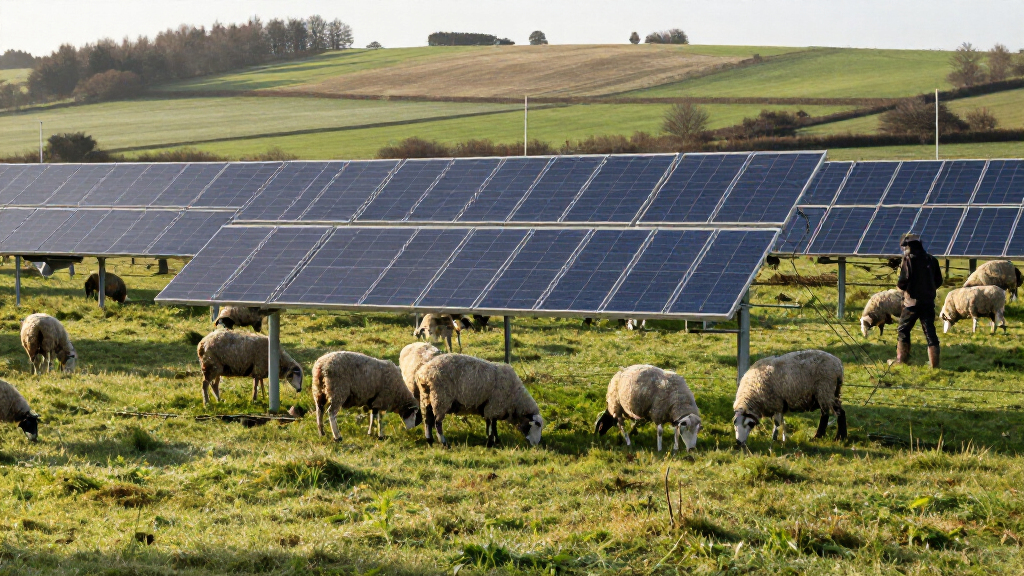
Two Cornell research papers published in October examine how sheep grazing can work alongside solar arrays: one reports that low-density grazing was associated with more beneficial insects than mowing, while the other presents a planning tool for farmers managing solar-grazing flocks. The findings speak to choices facing farmers and solar developers as they weigh vegetation control, farm economics and habitat.

Get garden gear delivered free with Prime
- Fast, free delivery on millions of items
- Prime Video, Amazon Music and more included
- Member-only deals all year
In a three-year field study at Cornell’s Cascadilla Community Solar Farm in Dryden, New York, researchers tested several sheep stocking rates, measured in animals per hectare. At two sheep per hectare, the abundance of wild bees, honey bees and lady beetles was 38% higher than at a mowed control plot, the team reported in “Low solar-grazing densities support beneficial insects in agrivoltaic systems,” published Oct. 7 in Environmental Research Letters. The increase was driven primarily by an 83% rise in honey bees, according to the paper’s findings.
The results differed at higher densities. At four sheep per hectare, beneficial-insect abundance was similar to the mowed control, while vegetation management was more effective than at the two-sheep rate. At eight sheep per hectare, the researchers reported the greatest vegetation management and high flock health, but honey bee abundance was 45% lower. The study therefore describes trade-offs across the tested rates rather than a single stocking level that maximizes every outcome.
A separate paper, “Flock Management for Solar Grazing,” published Sept. 28 in Manufacturing & Service Operations Management, describes a spreadsheet-based decision tool for sheep farmers. It helps users consider procurement and sales decisions using factors such as target flock size, costs, expected revenue and vegetation at a solar site. If a flock is too small to control grass, the model accounts for the need to manage vegetation another way. The researchers say the tool can also help solar developers understand farmers’ needs when developing contracts.
Sheep grazing at solar farms balances insects and vegetation
Two Cornell papers examine how grazing density affects beneficial insects and how a planning tool can help farmers assess flock needs and contract economics.
Grazing density changes the trade-offs
A three-year trial at Cornell’s Cascadilla Community Solar Farm compared three stocking rates with mowing.
| Sheep per hectare | Insects and vegetation |
|---|---|
| 2 | More beneficial insects than mowing |
| 4 | Insects similar to mowing; better vegetation management |
| 8 | Greatest vegetation management; high flock health; fewer honey bees |
A tool for flock planning
The spreadsheet-based model helps farmers and solar developers consider whether a grazing plan fits the site and the farm.
Consider target flock size and the site’s vegetation requirements.
Factor in procurement, costs, expected revenue and sales decisions.
If the flock is too small to control grass, account for another way to manage vegetation.
What the findings can guide
Farmers and developers can use the research to frame site and contract discussions.
- Compare stocking rates with site needs.
- Assess flock costs and expected revenue before a contract.
- Understand farmers’ operational requirements.
- Discuss vegetation plans and potential insect trade-offs.
Balancing Insects and Vegetation Control
The field results show why grazing density matters to more than the amount of vegetation sheep remove. In the reported trial, the lowest tested rate was associated with higher beneficial-insect abundance than mowing, while higher rates were more effective at vegetation management but did not produce the same insect result. That information could help farmers and solar developers compare possible trade-offs when setting grazing plans.
The second study addresses a practical constraint: farmers need enough animals to meet a site’s vegetation requirements, but acquiring and maintaining a flock involves costs and decisions about future sales. A tool that lays out those factors could help farmers assess whether a contract makes financial sense and help developers plan around the operation’s needs. The researchers do not report that the model guarantees profit; it is intended to support decisions using the inputs provided.
Together, the papers connect land management and flock economics in agrivoltaic systems, where agriculture and electricity production share a site. Their results may inform conversations among farmers, solar companies and local decision-makers, but the findings do not establish that every solar site will produce the same insect or business outcomes.
Popular right now

TCL 55-Inch T7 Series 4K QLED Smart Google TV, 55T7

De'Longhi La Specialista Touch Semi-Automatic Espresso Machine with Grinder

De'Longhi Classic Signature Espresso Machine with Adjustable Milk Frother
As an affiliate, we earn on qualifying purchases.
Two Studies, Different Questions
The insect study was led by researchers from Cornell’s College of Agriculture and Life Sciences, with scientists in entomology, ecology, animal science and plant science. The team used Cornell teaching sheep at the university-owned Cascadilla Community Solar Farm, comparing grazing densities with a mowed control over three years. Its focus was the relationship between stocking rate, vegetation management and beneficial insects at that site.
The management-tool paper came from a separate team at Cornell’s SC Johnson College of Business and engineering college. Assistant professor Vincent Slaugh began examining the economics and logistics after speaking with Ithaca sheep farmer Caleb Scott, founder of United Agrivoltaics. The tool has been incorporated into United Agrivoltaics’ onboarding process, according to the source material. Sheep farmer and solar-grazing consultant Nikola Kochendoerfer, who manages 700 ewes on solar installations in New York and Vermont, also contributed to the research on solar grazing.
The economic case may extend beyond individual contracts, but some of that case remains prospective. The source material notes that about half of lamb and mutton consumed in the United States is imported, primarily from New Zealand and Australia. Cornell researchers suggest that solar contracts could support flock growth; the papers do not establish how much the practice will expand domestic sheep production or change consumer demand.
“We’re trying to understand the connections between those pieces so that when solar developers, municipalities looking at solar development, or farmers are faced with a decision, they can have scientific information about potential trade-offs and synergies.”
— Steve Grodsky, senior author of the insect study and Cornell assistant professor
How Far the Findings Extend
The insect results come from one solar farm in Dryden and a three-year trial. The supplied information does not establish whether the same patterns would hold across different climates, plant communities, solar-array designs or grazing schedules. It also does not report the study’s full statistical details, so the findings here are limited to the comparisons stated by the researchers.
The management tool is designed to help users evaluate costs, flock size, revenues and site conditions, but no broad evaluation of its financial results is provided in the source material. The tool’s use by United Agrivoltaics shows adoption by that company; it does not, by itself, show that all farmers will benefit or that every solar-grazing contract is profitable.
It remains unclear how quickly solar grazing will expand, how many farms will adopt the model, and whether growth in sheep flocks would lead to more domestic meat production or changes in prices and supply chains. Those outcomes depend on decisions and market conditions beyond the two papers’ reported findings.
More Sites and Contract Decisions
The research points to practical next steps for farmers and developers: compare stocking rates against the vegetation needs of a specific site, account for potential effects on insects, and plan flock size and finances before signing a grazing contract. The Cornell field study offers evidence from one location, while the spreadsheet model gives farmers and developers a way to organize operational decisions.
The supplied material does not identify a scheduled follow-up study, a planned expansion of the field trial or a formal evaluation of the tool across multiple farms. Further reporting across sites, along with information on contract performance and flock outcomes, would help show how widely the findings apply. For now, the researchers’ reported results offer evidence for weighing site-specific trade-offs, not a universal prescription for grazing every solar array.
Key Questions
What did the Cornell insect study find?
At two sheep per hectare, the study reported 38% more wild bees, honey bees and lady beetles than at a mowed control plot. The result was driven mainly by an 83% increase in honey bees.
Did higher sheep densities also increase beneficial insects?
Not in the same way. At four sheep per hectare, insect abundance was similar to the mowed control. At eight sheep per hectare, vegetation management was greatest and flock health remained high, but honey bee abundance was 45% lower, according to the research team.
What does the solar-grazing tool do?
The spreadsheet-based model helps farmers consider flock size, costs, expected revenue, sheep purchases and sales, and vegetation at a particular solar site. It is a decision-support tool, not a guarantee of profit.
Do the results apply to every solar farm?
The insect study was conducted at one solar farm in Dryden, New York. The supplied research summary does not show whether the same results would apply across other sites, climates or grazing conditions.
Does the research show that solar grazing will increase U.S. lamb production?
No. The researchers describe flock growth and increased domestic production as potential outcomes. The papers do not establish that solar grazing will cause those changes.
Source: Hacker News